
Embedding a Sustainable Wellbeing Ecosystem: The Key to Psychosocial Safety and Staff Wellbeing
A Focus on Staff Wellbeing Is Not Enough. You Need a Wellbeing Ecosystem.
Most schools are working harder than ever on staff and teacher wellbeing. Policies are written, programs are funded, wellbeing days are scheduled. And yet staff still leave. Morale still dips. School outcomes still plateau.
The problem is not that schools are not trying to support staff wellbeing and enhance the working environment, but rather that the strategy is only partially complete.
The prevailing message to school leaders has been attractive for its simplicity: implement a wellbeing approach, add an initiative, list wellbeing as a strategic priority, and your school outcomes will improve. The truth is that improving school outcomes requires far more than words or dot points on a strategic plan. It requires an in-depth and honest assessment of the state of the school, and deliberate work on the conditions that shape the staff experience every day, with and alongside our people.
It is not as easy as A+B=C. If you improve staff wellbeing and mental health, then, as if by the wave of a magic wand, student and school outcomes improve. That is only one fraction of the system that needs to shift if we want to affect real and lasting change.
Why? Because there is more to our staff’s experience at work than just their personal wellbeing, mental health and application of coping strategies. Mentally well staff can still work inside systems or conditions that are not conducive to influencing outcomes.
Dare I say it, if we continue pushing on with all the personal wellbeing initiatives without a focus on the working conditions, we’ll have more and more staff realise, that this simply isn’t the job for them anymore.
Staff wellbeing is a complex, interwoven ecosystem, composed of multiple coexisting elements that influence one another, often shaped by leadership and organisational conditions, all of which shape staff experience and contribute to a functioning system.
The Problem with Isolated Approaches to Staff and Teacher Wellbeing
The literature on staff wellbeing in schools generally falls into one of three camps. Each has merit. Each, on its own, falls short.
THE SYSTEM-REFORM CAMP: Argues that the system needs to improve conditions for schools through review or reform. Focus sits with the government, departments and policy.
THE LEADERSHIP-PRACTICES CAMP: Argues that schools and leaders should enhance their practices, processes and frameworks. Focus sits at the school level, on what leaders do.
THE INDIVIDUAL-RESILIENCE CAMP: Argues that teachers and staff need to develop their own wellbeing capacities. Focus sits on individual resilience, self-awareness and coping strategies.
The problem is that these camps are generally presented in isolation, rarely as part of a holistic and integrated approach. So what happens? People start pointing fingers and nothing changes.
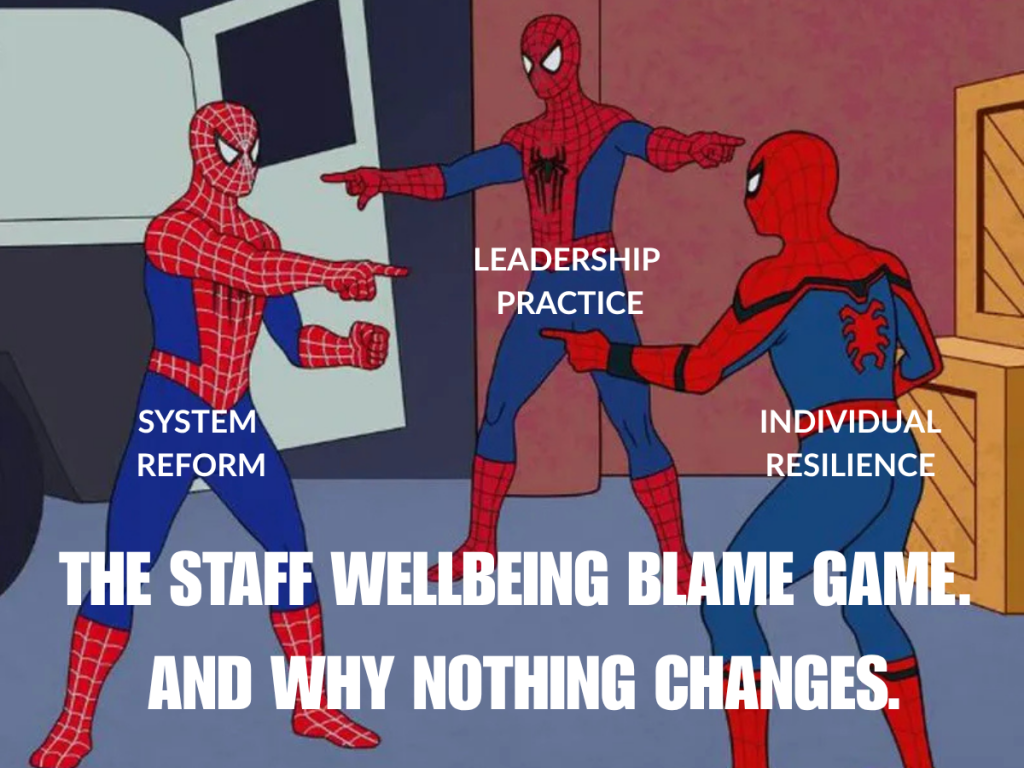
I cannot tell you how many times I have heard staff and leaders “blame” the system, the community, COVID, parents and/or one another for the stressors experienced in schools. I know the state of education is flawed. But blame stifles inquiry. I will always encourage schools to focus first on what they can affect and control.
THE FOURTH CAMP – THE ECOSYSTEM CAMP: The Staff Wellbeing Ecosystem sits as the fourth camp. It is the integrative alternative. Rather than choosing between system, leadership, or individual capacity, the ecosystem recognises that all three operate together. When established and considered within a school, the ecosystem also helps the school community (leaders, teachers, and staff) navigate systemic factors both within and outside their direct control by focusing on what they can control.
The Staff Wellbeing Ecosystem
The Staff Wellbeing Ecosystem operates as an interconnected system with three layers.
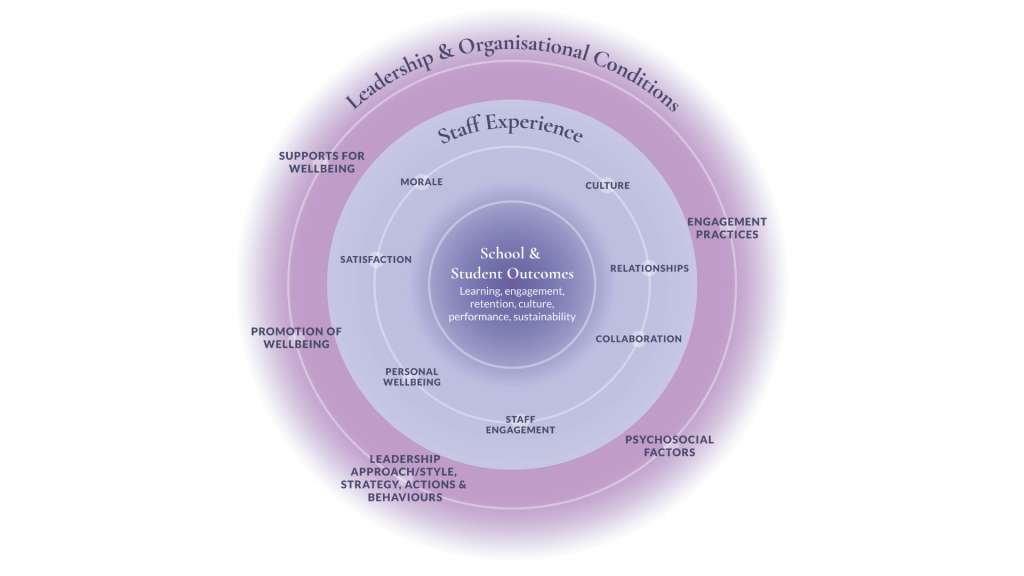
At the centre are school and student outcomes such as learning, engagement, retention, culture, performance and sustainability.
Staff experience is the inner ring. It is influenced by morale, culture, relationships, collaboration, engagement, personal wellbeing and satisfaction. These elements are what staff feel, do and receive every day.
Each of these elements has the power to influence the others. I.e., if staff morale is impacted, it can influence staff relationships. If satisfaction is low, this can impact personal wellbeing.
Leadership and organisational conditions form the outer ring. This includes leadership approach, strategy and behaviours, engagement practices, psychosocial factors, and how wellbeing is promoted and supported.
Again, these elements influence one another: the promotion and support of wellbeing are conducive to engagement practices, and leaders’ approaches influence psychosocial factors.
Leadership and organisational conditions are where the greatest leverage exists. These conditions help to shape staff experience.
When the ecosystem is aligned, staff feel supported, engaged and psychologically safe. That alignment is what produces sustainable improvement for the school and students.
A Joint Responsibility
The Staff Wellbeing Ecosystem cannot be the responsibility of any one group. While school leaders drive the conditions, teachers and staff also actively contribute to shaping the working experience of themselves and their colleagues. All individuals also have some level of control over their experience. While staff experience is certainly shaped by working conditions, these elements are more robustly developed through the participation, buy-in, and involvement of all staff in a school.
This is not about one side fixing the other. It is about a whole-school ecosystem working together.
What the Data Tells Us
Across 75+ schools and thousands of staff, my Staff Wellbeing Survey result averages reveal a clear pattern. The inner ring of the ecosystem (staff experience) is holding up, but the outer ring (the organisational conditions with the most leverage) is where the system is breaking down.
Staff Experience: The Inner Ring
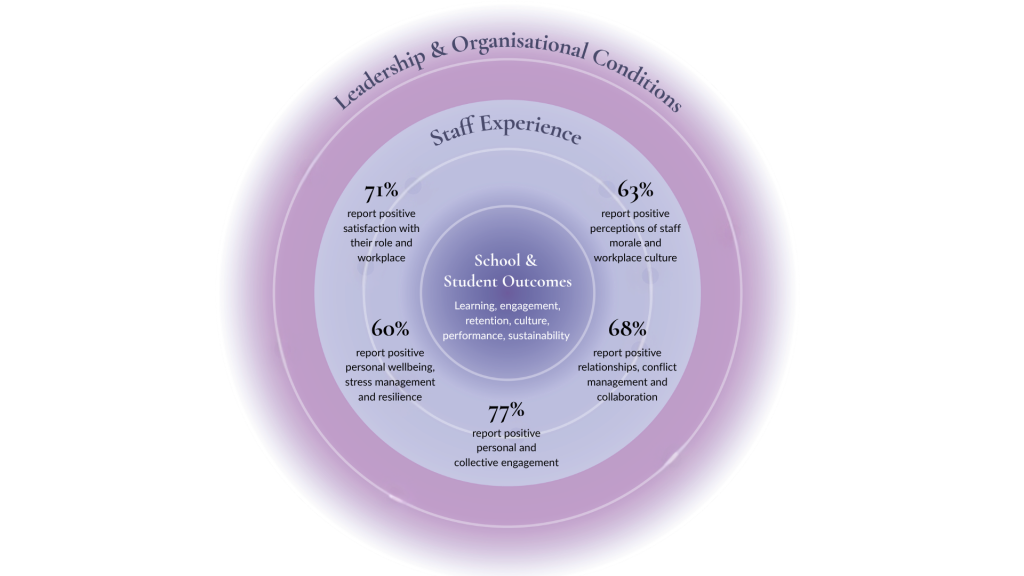
Staff experience regarding job satisfaction, perceptions of staff morale and culture, relationships, engagement and personal wellbeing sit between the low 60s and high 70s. With well over half of staff agreeing that their experience is positive, this tells us that our purpose-filled profession is doing heavy lifting to keep the inner ring strong, even in difficult conditions.
Leadership And Organisational Conditions: The Outer Ring
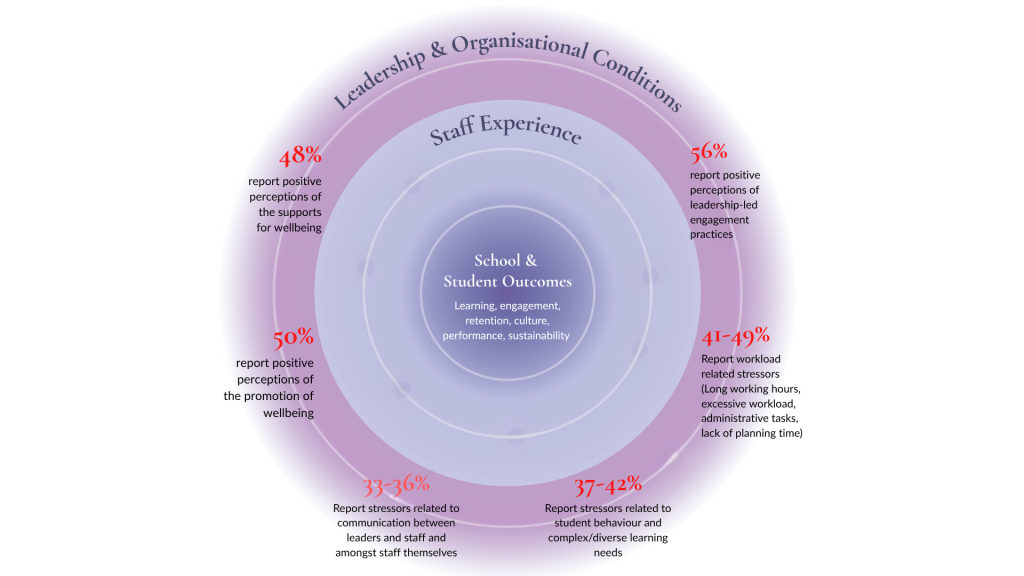
Here is where the drop appears. The organisational conditions with the greatest leverage on staff experience are also the weakest-scoring elements across our national data. The number of staff who report positively on the support and promotion of wellbeing and leadership-led engagement practices ranges from 48% to 56%.
This is not a failure of staff resilience alone. It is a signal that the conditions shaping their experience need strategic attention and that everyone in a school and the system shares responsibility for enhancing staff experience to improve outcomes.
This national data confirms a critical reality: while staff purpose keeps the inner ring afloat, the organisational conditions in the outer ring are where systems are breaking down. However, these ecosystem pressures don’t manifest equally across every school setting. A specialist setting, a regional secondary school, and an above-average primary setting each carry distinctly different hazards. To see how these ecosystem dynamics break down across your specific ICSEA setting, you can read our complete 2026 band-by-band national analysis.
The Top Psychosocial Stressors
When we ask staff what is affecting them most at work, three categories consistently emerge:
WORK DEMANDS:
- Long working hours or excessive workload (49%)
- Administrative tasks (48%)
- Lack of planning time (41%)
- Staff shortages (36%)
STUDENT BEHAVIOUR AND NEEDS:
- Managing difficult or challenging student behaviour (42%)
- Catering for diverse or complex student needs (37%)
COMMUNICATION:
- Poor communication between leaders and staff (36%)
- Poor communication between staff (33%)
These are not averages to apply as a cookie-cutter approach. Every school’s psychosocial profile is different. But the national pattern shows where the most common leverage points lie.
Leadership as the Foundation of a Wellbeing Ecosystem
Every organisational condition in the outer ring ultimately comes back to leadership (at a system and school level). How leaders lead, their approach, strategy, actions and behaviours, and their own wellbeing, shape everything else in the ecosystem.
Research confirms that principal leadership has a statistically significant positive effect on student achievement (Liu, Bellibaş & Gümüş, 2021). Any leadership approach, when done well, can influence student outcomes. Instructional leadership shows the strongest research effect (Robinson, Lloyd & Rowe, 2008), but in my experience, transformational and authentic leadership approaches are also highly conducive to wellbeing when they are done well.
The common pitfall I see is this: leaders tend to focus on the relational and human capabilities of transformational leadership while neglecting the instructional focus on high expectations, people management and staff development. The strongest leadership approach holds both.
Leadership is not one of many organisational conditions. It is the undercurrent of all of them. It is where the ecosystem is either built or broken. This important foundation highlights the need for the system, schools and individual leaders themselves to prioritise the time to align approaches, develop capability, plan, collaborate and reflect to affect change. While staff certainly have a responsibility to participate in school reform, adapt their mindset, and support their wellbeing, it is our leaders who are appropriately tasked with leading these initiatives.
Which Element Is Your School’s Weakest Link?
Not every school experiences ecosystem challenges in the same way. Some staff may report strong personal wellbeing but feel disengaged. Others may feel energised in their work yet experience strain in relationships, communication, or culture.
This is why a one-size-fits-all wellbeing strategy, or a psychosocial risk assessment tool used in isolation, rarely works.
The starting point for addressing and improving wellbeing and psychosocial safety must be pinpointing what the staff experience is being shaped by in your school, using meaningful data, staff voice and contextual insight.
FOUR QUESTIONS TO ASK YOUR LEADERSHIP TEAM
1. Which element of your staff experience (inner ring) is strongest, and which is weakest?
2. Which organisational condition (outer ring) is likely to score lowest in your school?
3. Is your current wellbeing work focused on what staff most need strengthened, or on what feels easiest to deliver?
4. What would change if you anchored your next wellbeing decision in data rather than intuition?
Focusing on the right conditions matters. In my work across schools, I have found that when we align our efforts with what staff are actually experiencing, and with what they want to improve, wellbeing work becomes more strategic, more relevant, and far more likely to create lasting change.
WANT THE FULL VERSION?
This article is a condensed look at the Staff Wellbeing Ecosystem. For the full research methodology, a deep-dive analysis of each ecosystem layer and the complete evidence base, download our comprehensive report >> DOWNLOAD THE FULL REPORT HERE <<
Take the Next Step: Join My Free Training
If you are ready to move beyond reactive policies and start managing psychosocial risk in a way that is both authentic and strategic, I invite you to join my upcoming free online training: Psychosocial Risk Management: A Practical and Authentic Approach.
We will dive deep into how to align Safe Work obligations with a genuine, human-centred culture, using a proven 6-step framework to bridge the gap between compliance and true staff wellbeing. Registrations open next week at adriennehornby.com.au/training.
From the blog
Psychosocial Safety Is the School’s Duty, but Everyone Is Responsible for the Work
When we talk about staff wellbeing and psychosocial safety in schools, two camps tend to form. One points to data on stress and burnout and…
Who Owns Staff Wellbeing? Why Leaders Must Make the First Move
I’ve had three calls with principals since the term started. All across different states, sectors, and sizes, and all three said a version of the…
The State of Staff Wellbeing in Australian Schools: What Our National Report of 4,536 Staff Reveals
One in two school staff report feeling burnt out, and only 57% say their workplace has a positive impact on their mental health. For years,…