Staff Wellbeing in Below-Average ICSEA Secondary Schools: Data, Hazards, and Controls
Recently, we released The State of the Nation: Band Analysis report, exploring the state of wellbeing across Australian schools segmented by primary, secondary and specialist settings and broken down by below, at and above ICSEA score averages. The Band 1H (below-average ICSEA Secondary Schools) findings are the most confronting. They are also the clearest argument we have that staff wellbeing in Band 1H schools is largely a conditions problem, not a people problem.
There’s a type of school leader I think about often in my “off hours”; they are the kind of leader I work with inside our school partnership program: the ones navigating a relentless workload, constantly putting out spot fires, and trying to get to know their staff in record time, all while leading a team where some members are “bristly” at best. These are often the leaders who take weeks to respond to my emails, if at all.
But these are also leaders who excel at translating system demands into something their staff can carry, while simultaneously translating what their people are holding into something the system will hear. They are good at it. However, they’re also exhausted by it. Long before any national dataset existed, they suspected their school was working against a headwind other schools would never feel or could come close to understanding.
The data now proves they were right all along…
What the Numbers Show
The State of the Nation: Staff Wellbeing Across Australian Schools report draws on survey responses from 4,536 staff across 58 school communities, analysed across seven ICSEA bands.
Band 1H, secondary schools below the average ICSEA range, stood apart from every other group in the dataset on measure after measure. And the results were not in a direction anyone would hope to see.
Perceptions of high morale in this band sit at a drastically low 27%. The national figure is 50% (which is itself alarming). Stress linked to staffing shortages reaches 63% of staff, against 40% nationally. And 71% report poor communication between leaders and staff, nearly double the national figure of 36%.
Sit with that last figure for a moment, because it’s the finding people misread fastest. The immediate instinct is to hear “poor communication” as an indictment of leadership capability. However, the data points to a systemic breakdown and dwindling capacity rather than a leadership failure.
Tell me, how is it possible that a large majority of leaders across an entire ICSEA band are inherently “poor communicators?”
The Pattern Underneath
These three numbers are not three separate problems. They represent one system and a cluster of vulnerable settings under strain, viewed from three different angles.
1. High leadership turnover
A school running with unfilled and high-churn positions is a school where leaders spend their days covering classes, patching timetables and managing crises. Communication is not neglected because leaders do not value it. Instead, it’s swallowed whole by operational overload. Briefings get cut short or cancelled entirely as leaders tend to the next spot fire. With limited time to prepare and gather as a staff, the consultation gets skipped. The feedback loop, the very mechanism that assures staff their voice landed somewhere, stops closing. This happens not because leaders don’t care, but because they are constantly in survival mode or have bigger fish to fry.
Further, with every new leader comes the next wave of change, a shift in strategic direction and an influx of initiatives to introduce and attempt to embed. Staff grow frustrated that the program the last leader introduced gets tossed to the side. All of this, amongst changing system directions, makes this a pressure cooker for staff frustration and confusion.
2. A lack of consultation and staff voice
Staff then experience the direct consequences reported in this band: decisions that arrive without context, workload that arrives without consultation, and effort that seems to vanish without acknowledgment. Morale does not collapse because leaders lack the skill or ability. It collapses because not being heard, involved, or included is one of the most corrosive experiences a workplace can offer its staff.
3. Complex student needs and behaviours
Underneath both sits the daily reality of the classroom. In this band, 58% of staff reported managing difficult and challenging student behaviour as a key stressor, and Band 1H staff were among the few nationally to name occupational violence related to students, alongside pastoral concerns, as hazards in their setting.
These schools serve communities of below-average socio-educational advantage, which frequently means higher concentrations of complex need.
A lack of consistency or shared understanding in the whole-school approach to student management and wellbeing was one of the key hazards they reported, with 48% asking for more focus on student management, behaviour and wellbeing as a control.
What I see in my work is that schools say they adopt an approach, but this approach is often not yet shared or consistent across learning spaces.
When every classroom or space runs its own rules or has its own set of expectations that don’t mirror the next, every incident becomes a negotiation, and the mounting, stacking stressors and frustrations with the inconsistencies erode workplace relationships, trust and civility amongst staff that these schools depend on most.
When you step back, you realise these aren’t three separate issues but one self-reinforcing loop. Leadership churn stifles and interrupts communication, even with the best of intentions. Fewer opportunities for communication and consultation silences staff voice. And unsupported complexity in the classroom drives the shortages and strain that churn leaders and staff in the first place. The loop closes on itself, which is why the report argues these settings need systemic attention, not another isolated initiative.
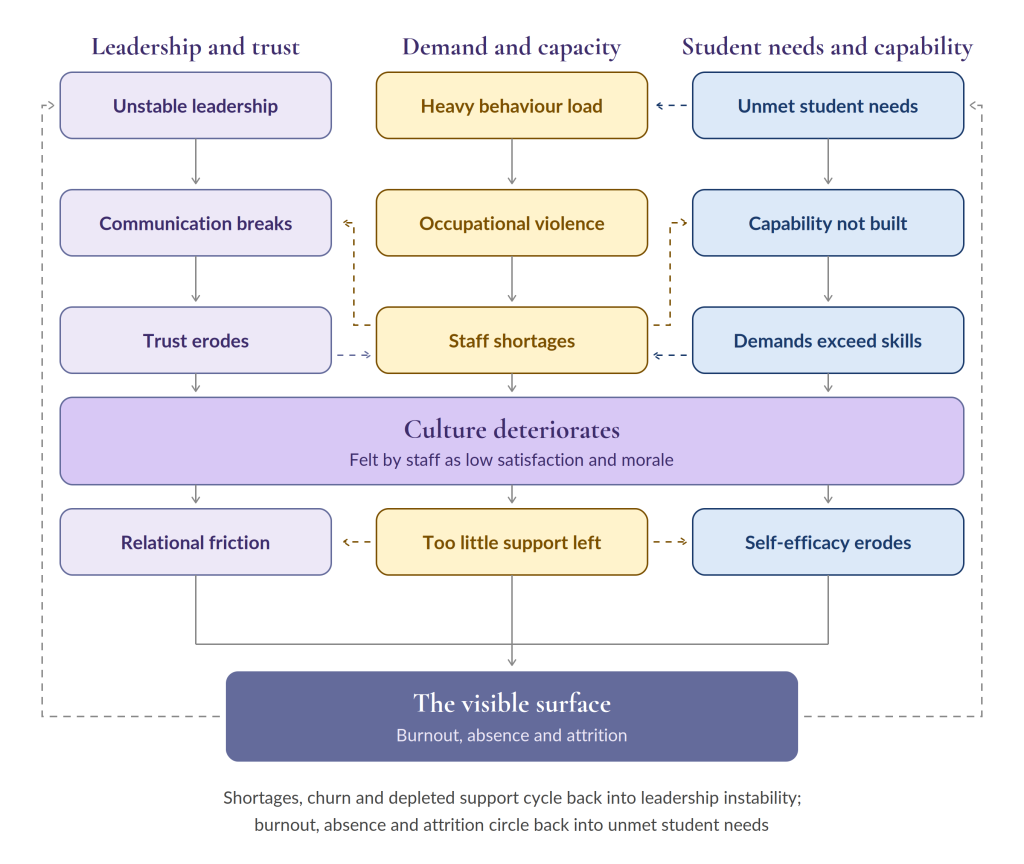
This is why the report is blunt on one key point: the pattern is consistent across states, sectors and school sizes. When the same profile surfaces in Band 1H Schools nationwide, the explanation is not weaker leaders or less committed staff. It’s organisational conditions.
The report is equally careful to note that these figures reflect correlations and patterns in staff reporting rather than direct proof of cause. However, the sheer consistency of this pattern is a definitive finding in itself, and it’s deafening.
What Other ICSEA Bands Can Learn from Band 1H Findings
If you lead in a Band 1H setting, this section of the report was written for you. However, these findings are critical and relevant even if you’ve never set foot in a below-average ICSEA school. Band 1H schools reveal what any school’s psychosocial risk profile looks like under maximum load.
The underlying psychosocial hazards are the same hazards that exist everywhere, especially in schools navigating complexity brought about by a range of reasons: high systemic or school-based change, work demands, shortage stress, communication breakdowns, and complex student needs. Band 1H secondary schools typically simply carry more of these hazards simultaneously with the least amount of slack in the system to absorb any of them.
This makes Band 1H schools the strongest evidence in the national dataset for a core argument of the report: you cannot train individuals out of hazards that live within their working conditions. A resilience program does not fill a staffing vacancy. A wellbeing day does not close a feedback loop.
Under the Safe Work Australia Code of Practice, psychosocial hazards in schools must be managed like any other workplace risk: identify them, assess them, consult your staff, put proportionate controls in place, and review them regularly.
Where the Hope Sits
Conditions can be changed, and the data itself points to where to start. Communication is one of the few hazards in the dataset that costs more attention than money, which matters in schools that have little of either to spare.
Improving staff wellbeing in below-average ICSEA secondary schools requires system controls designed for this specific profile:
- Invest in the time to build relationships and trust with school communities: Get to know staff, consult, listen, close the feedback loop, and build relationships before introducing change or a shift in priorities (system or school level)
- Embed strong communication structures, protocols and norms: Regularly revisit, refer to and utilise to keep at the fore
- Develop a consistent, whole-school approach to behaviour and wellbeing, positive behaviour support, restorative practices and trauma-informed frameworks: Build a team or committee responsible for maintaining an enduring approach
- Build and ensure strong induction programs, resources and tools: Plan for their continuation amongst changes in leadership via strong processes, committees and staff involvement
- Build a shared understanding of school approaches, frameworks and policies: Prioritise coaching, mentoring, continuity programs and focuses over more one-off professional learning
- Invest in leadership development, unification and a shared vision, and in stabilising and supporting leaders through change
- Build strong people-management skills, with clear structures and staff norms that hold the line on below-the-line behaviour
A Note to Educators
A public service announcement for any Band 1H school leader, teacher or staff member reading: Your schools are not failing against the national average. Your school is carrying a different load, and deserves to be measured, resourced and supported accordingly.
Read more about the key data findings, the insights within the literature and more detailed recommendations in the National Band Analysis Report:
Get the Support You Need to Build Sound Organisational Conditions
Knowing where the hazards live in your data is one thing; having the strategic architecture to systematically address them is another. That is why we built the Well-Led Schools Partnership Program. Designed as a comprehensive, 12-month roadmap, we work alongside your executive team to thoroughly assess your school’s unique psychosocial risks and hazards, delivering tailored expert recommendations and organisational controls.
Rather than imposing top-down mandates, the entire process is conducted in deep consultation with your staff at every stage, ensuring their lived experience directly shapes the path forward.
Through guided workshops for both leaders and staff, structured strategy calls, and a clear, actionable Wellbeing Action Plan, we help you replace reactive firefighting with a sustainable strategy that keeps your entire school community accountable to long-term safety and trust.
Ready to move beyond surface-level fixes? Partner with us through the Well-Led Schools Partnership Program to start building a safer, more resilient school culture.
From the blog
Who Owns Staff Wellbeing? Why Leaders Must Make the First Move
I’ve had three calls with principals since the term started. All across different states, sectors, and sizes, and all three said a version of the…
The State of Staff Wellbeing in Australian Schools: What Our National Report of 4,536 Staff Reveals
One in two school staff report feeling burnt out, and only 57% say their workplace has a positive impact on their mental health. For years,…
What 4,536 Australian Educators Told Us About School Staff Wellbeing | Season 4: Episode 13
Only 57% of Australian school staff report that work positively affects their mental health, and 1 in 2 are currently experiencing burnout. When I sat…