Who Owns Staff Wellbeing? Why Leaders Must Make the First Move
I’ve had three calls with principals since the term started. All across different states, sectors, and sizes, and all three said a version of the same thing: “Things have changed. When I first started teaching, we looked after our own wellbeing. Our staff seem to think it’s up to the school to fix things. They play their part in staff wellbeing and culture too.”
Reading between the lines, what I was hearing was closer to “we are doing so much, and it feels like nothing has shifted or is working.” I want to be careful here, because I have sat exactly where they sit. But I noticed two things on those calls, and they are the same two things I notice in almost every first conversation with many of the schools I’ve worked with.
First, each of them, without meaning to, pinned the responsibility somewhere else. And when I speak with staff in those same schools, they do the same thing in reverse, pointing to their leaders. This starts to feel and sound like blame.
Second, when I probe deeper, staff rarely have a clear, accessible process to raise a wellbeing or safety concern, or to know it will be acted on and communicated back to them. Which is interesting, because when we ask staff what would actually help, ‘a clear and accessible process for raising wellbeing or safety concerns’ has been climbing the rankings in our survey data this year.
None of these schools has a doing problem. They have an order problem, and the first sign is usually where the finger points.
Why so much effort is going so little distance
I will not spend long on the kinds of initiatives schools are deploying: the EAP, a wellbeing day, staff breakfasts, a keynote in week one, a committee, a policy. None of it is wrong, and staff can respond well to them, and someone introduced every item by following the advice they’d been given. The tension is that each one supports people already under strain, and it rarely changes the conditions producing the strain. The Code of Practice for Managing Psychosocial Hazards at Work outlines for us that policies, training and programs are administrative controls, “the least reliable”, and should be considered “last” and used “in combination with more effective controls” (Safe Work Australia, 2022, s 5.1).
Our data from 4,536 staff in 58 Australian school communities clearly show the conditions educators operate under: long hours (51%), administrative load (51%), and complex student needs (51%), followed by student behaviour (46%) and leader-to-staff communication (46%). Not one of those is solved by an early mark on a Wednesday. Damage does not follow demand; it follows conditions.
There is a legal reason for this approach and method. The duty to eliminate or minimise psychosocial risk sits with the school as an organisation (WHS Act 2011, s 19), and officers hold a personal duty on top of that, including to “verify” that the school’s processes for hearing and acting on concerns are “performing effectively” (s 27; Code s 1.2). I want to linger on the word “verify”, because filing a risk assessment does not verify anything. The Code itself recommends a set sequence: 1. identify, 2. assess, 3. control, and 4. review, supported by consultation and commitment and engagement from senior leaders at every step (ch 2). A school whose whole approach lives only in offering support or morale-boosting initiatives has started at step three and skipped the first essential steps. This is why attempts to address wellbeing often fall flat.
The Tell, and What Sits Underneath It
I can usually tell where a school is in its wellbeing journey within the first ten minutes of a call, or when reading survey responses, by where it places responsibility. Leaders say staff need more resilience, more perspective, more willingness to engage. Staff say something along the lines of that leaders need to fix the workload, start communicating and/or improve consistency. Both are partly right, but so long as the responsibility sits on the other side of the table, nothing moves and nothing changes.
The psychology of this is well mapped, and knowing it takes the sting out. We explain other people’s struggles by their character and our own by our circumstances, so a leader watching their staff struggle sees someone who is not coping, while the staff member living the same week can’t see past their workload (Ross, 1977). Under pressure, we sort into groups and the other group gets the blame; here we start to hear the “us and them” narratives (Tajfel & Turner, 1979). Blame is what stressed and unsafe humans do. Blame is often rife in schools where hazards and stressors stack up and risk increases.
Telling a school that staff wellbeing is a joint responsibility changes almost nothing on its own, even though it is true and one of the guiding principles that a Well-Led School is built on. But…you can’t simply declare your way out of a mindset. You have to take the walls down in an order that makes it safe to stop blaming others and start owning, and that order is not just a sequence of actions. It’s a sequence of mindset shifts, and leaders need to make the first move. They are, after all, aptly titled.
Staff do not adopt a mindset because they are told to. They mirror the one they see modelled, and they mirror the people with the most status in the room most closely. (Bandura, 1977). That is why I have spent years conceptualising and teaching the Staff Wellbeing Sweet Spot and the Well-Led Schools Ecosystem, and why the journey described in the next section runs in the order it does. It can be done.
Anne Burgess, principal of James Cook Primary, told me after two survey cycles that “us and them is now a thing of the past”. Her morale data had moved from 52% to 86%.
One thing to be clear about before I go on. “Leaders go first” does not mean staff wait on the sidelines. Staff hold responsibility from day one for their own wellbeing, for how they treat the people around them (including leaders), and for raising concerns early. But in some schools, the organisational psychology really depends on leaders moving first. When leaders take ownership of the conditions, staff feel safe doing their part and claiming their share of the responsibility. I wish it didn’t work that way, as I know how it can make leaders feel. It is simply what I have seen, time and again. As you read through the stages, you will notice where I suggest leaning more heavily on staff responsibility. The key message is not that it doesn’t belong. It’s that many schools lead with it too early.
A Well-Led approach is built through a journey
The journey synthesises the research and what I have seen across more than 80 schools; it’s the rationale behind our six-step framework. Underneath it is the Code’s own risk management process, built on Helen Timperley’s Spiral of Inquiry. It has five stages, and each builds on the last. For each one, what matters most is the shift leaders make and what staff take from watching them.
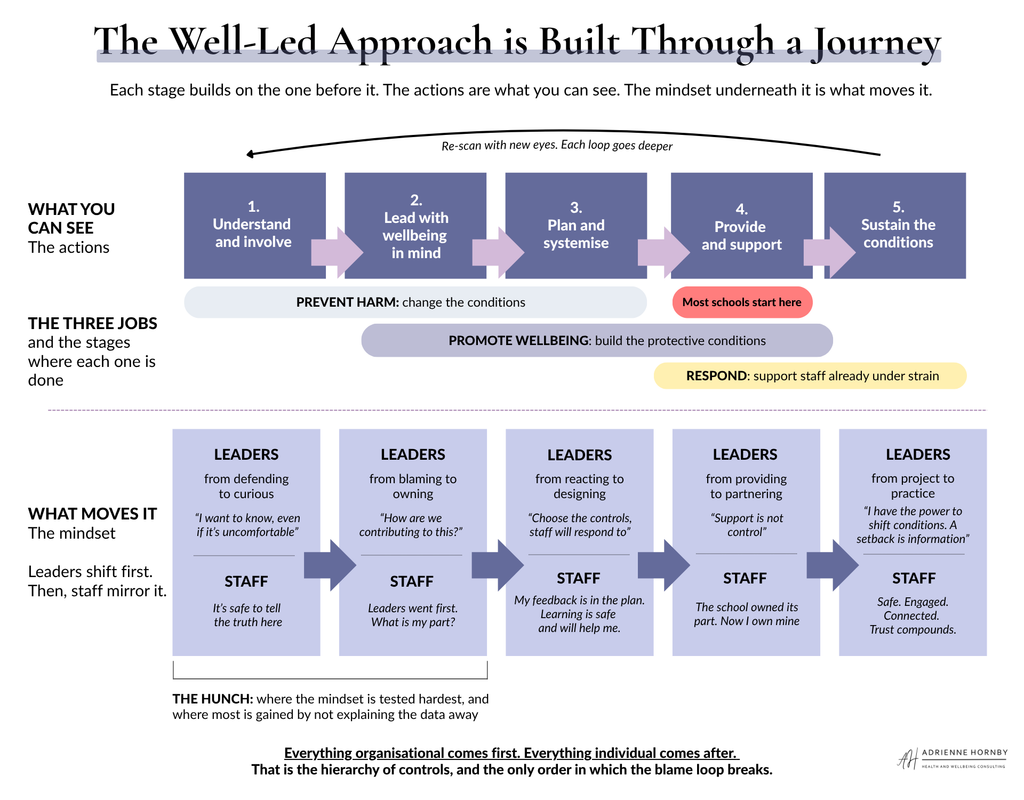
Stage 1. Understand and involve
The shift for leaders: from defending to curious. This stage asks a school to scan wellbeing, survey their staff and gather a broad range of staff voice and data, then involve staff in making sense of it, because leaders who interpret their own data behind closed doors have consulted nobody. From this process, the school (inclusive of staff) identifies strengths, hazards, risks and/or areas of opportunity. The mindset underneath is “I want to know, even if it’s uncomfortable”, and this is where the hunch begins: looking beneath the surface at the real conditions and starting to own the school’s part in shaping them. When the data lands, the temptation is to explain it away. Labelling it as a bad term, a few loud voices, or a badly timed survey.
What staff take from it: it’s safe to tell the truth here. Only 43% of staff nationally feel encouraged to speak openly about their wellbeing at work, and when staff are asked what would help, the answer that keeps rising is not another initiative. It’s a clear and accessible process for raising concerns. Staff are asking for the thing the law already requires, because the Code makes consultation a duty rather than a courtesy, including the duty to “advise workers of the outcome” (s 1.3). Staff only tell the truth about conditions when it’s safe to (Edmondson, 1999), and being asked, and feeling like that feedback registered somewhere (even if it isn’t acted on), is what makes it safe. The timing matters as much as the telling. A survey that goes quiet for a term teaches staff that nothing will come of it, and the Code is specific that the outcome of consultation must be shared “in a timely manner” (s 1.3). Report back within weeks, not terms, even if all you can say is “here is what we heard, and here is what we are working on first” or “Your feedback requested X, this is why that can’t be achieved, but let’s explore some other solutions together.” Three high-leverage and high-impact priorities come out of this stage, not ten competing ones.
Stage 2. Lead with wellbeing in mind
The shift for leaders: from blaming/deflecting to owning. A school’s approach to wellbeing takes its tone from its leaders, and this is where the hunch that began in the scan has to be said out loud. Timperley’s spiral calls it ‘developing a hunch,’ and the question is intentionally uncomfortable: how are we, as professionals, contributing to this? Timperley and her colleagues describe it as the hardest phase of the inquiry, because it asks leaders to consider their own practice as part of the circumstances (Timperley, Kaser & Halbert, 2014). Leaders set the conditions, so they bear the first responsibility to examine them honestly.
Prevention starts with ownership. You cannot control a hazard you’ve decided isn’t yours. When leadership treats wellbeing as part of the school’s purpose and models it visibly, staff are more willing to be honest, seek support, and engage with the work. So leaders form a view about what the school, as an organisation, will do, and they say so publicly before anyone else is asked to do anything.
What staff take from it: leadership went first, so it’s fair now to ask what my part is. This is why my 6 Step Framework runs two steps here in a deliberate order: co-creating the vision and a shared language for wellbeing, then clarifying the joint responsibilities. Only once staff have been heard and seen what the school will own is it reasonable to ask for their part, and when you do, the answer is rarely defensive.
Reversed, you get the blame loop. Run them in this order, and the walls start to come down. Schools stall when they delegate wellbeing to an enthusiastic committee with no authority over the conditions.
Mick Sloane at Denison College did it in this order, and twelve months later ‘leaders communicating about wellbeing’ had moved from 58% to 77%, wellbeing as part of the school’s values from 58% to 75%, and morale from 62% to 73%. What changed was that leadership had gone first.
Stage 3. Plan and systematise
The shift for leaders: from reacting to designing. This stage turns the priorities into a documented Wellbeing Action Plan and strategic roadmap, owned by a team, built with staff, and woven into how the school already runs: meeting cycles, workload decisions, timetable, induction. Done in the right order, this is where prevention and promotion are designed in deliberately rather than hoped for.
The mindset here is restraint. The plan starts drafting straight after the scan, because staff have told you what they need, but it is finalised only once leaders and staff have learned enough to choose appropriate controls rather than copy them. Schools stall when plans are written too early, or by an external consultant alone, resulting in plans that reflect assumptions rather than needs, or documents that sit unrevised and unimplemented.
What staff take from it: my feedback is in the plan, and learning is no longer an accusation. This is where professional learning and self-reflection become possible: because the organisation has already owned its part, a session on coping strategies or communication reads as development rather than deflection.
Lumen Christi College in WA chose three priorities from their scan: workload, communication and planning time, and twelve months later all three had moved below the national averages. This was because they identified 3 high-leverage, high-impact priorities and worked on them strategically.
Stage 4. Provide and support
The shift for leaders: from providing to partnering. This is the support, training and responsive help staff need, and when done well, they are there because staff asked for them and because stages one to three said they were the right ones.
They sit on top of changed conditions rather than replacing them. The mindset to watch here is what psychologists call action bias: the pull to do something visible because doing something feels like progress, even when the better move is to understand the problem first. A wellbeing day looks like leadership. Sitting with uncomfortable survey data does not. Which is why this isn’t just where schools stall. It’s where they camp. Helping people cope, encouraging or offering support is not the same as changing the conditions. This is where promotion, building a culture that visibly values wellbeing and encourages staff to speak openly about it, meets response, supporting the staff who are already affected. Both are important. Neither is prevention.
What staff take from it: this is where personal responsibility legitimately enters the chat, and I want to be clear about that because the blame loop runs in both directions. Staff also have a duty to take reasonable care for their own health and safety and for the people around them (WHS Act, s 28). The Act places the primary duty on the school. A worker’s duty is to take reasonable care, not to manage the risk. Once staff can see that the organisation has done its part, or is working towards it, they are far more open to owning theirs: their own wellbeing, their own conduct, and raising concerns through the process that now exists. Ask for that at stage one, and you get resistance. Ask for it here, and you get partnership. The sequence and the journey is the point.
Stage 5. Sustain the conditions
The shift for leaders: from project to practice. The final stage is to review, re-survey, close the loop with staff, adjust what didn’t work, and go back to stage one with new eyes. The mindset is consistency, and the real and most truthful part is that a setback is information, not failure. One of our guiding principles is “awareness is the first key to change”, affirming that, if we let it, this is an improvement or enhancement opportunity.
An approach is only as good as the culture that sustains it, and three everyday conditions hold it together: whether staff feel safe to be honest, whether they feel satisfied and engaged in their work, and whether they feel connected to one another. The re-survey should measure those three, because they determine whether everything in the earlier stages takes root and allows change to flourish. Timperley calls her framework a spiral rather than a cycle because each loop should take the exploration deeper. I call it ‘The Wellbeing Weave,’ from initiated to building to embedded. Schools stall when the first year was a project and the second has no owner.
What staff take from it: trust that compounds, and a return that finally shows up in the data. When a school sustains the conditions, staff experience shifts across the board: loyalty, respect for leadership, morale, culture, whether staff would recommend the school as a place to work, and whether they stay.
That is the Well-Led Schools Ecosystem doing what it’s built to do, because conditions shape staff experience, and staff experience shapes school and student outcomes. Every time leaders close the loop, even on things still in progress or the things that didn’t work, trust grows a little more. Staff who raise concerns and hear nothing back stop raising them (Morrison, 2014), which is why the process the three principals’ schools were missing only works if someone reports back.
James Cook Primary got to “us and them is a thing of the past” across two cycles, not one, with morale and “would recommend this school as a place to work” both moving from 52% to 86%. Anne Burgess did not run more initiatives in year two. She kept the conditions stable.
Why the Order is What It Is: How the stages, the steps and the Code line up
Put the five stages next to the six steps of the Partnership Program, the Spiral of Inquiry and the Code of Practice, and the method stops looking like a sequence of actions and starts looking like a sequence of mindsets. Each stage earns the right to ask for the next one.
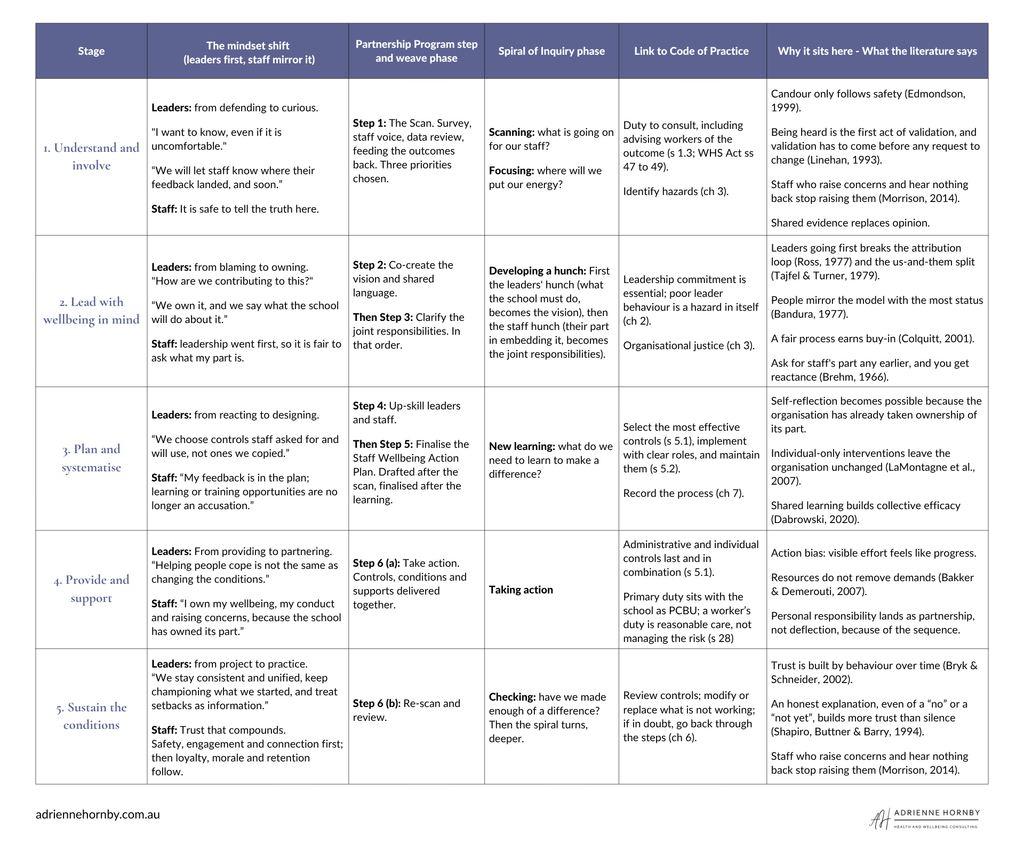
Download the PDF of the stages and steps here
In a nutshell, even though I know that some might not like to hear it, everything organisational comes first. Everything individual comes after. That is not a preference; it’s the hierarchy of controls, it’s what the data supports, and it’s the only order in which the blame loop is finally interrupted. The Staff Wellbeing Sweet Spot defines what we are building: workplace wellbeing and personal wellbeing. In my experience, and based on the research and the evidence-based models listed in this article and in the table, we are more effective when we start with the workplace. The Well-Led Schools Ecosystem shows what drives it and how and why it impacts students’ outcomes and school performance. The Wellbeing Weave gauges how deep the work has gone. The journey is how a school moves through it all, and the mindset drives it.
The Three Jobs of a Mature Approach
There is a quick way to test where your school sits on this journey, and it takes about two minutes. A mature approach to staff wellbeing does three jobs at once (LaMontagne et al., 2014).
- It prevents harm by changing the conditions that produce it. Rebalancing workload across a term. Cutting a meeting. Fixing how decisions get communicated. This is the work of stages one to three, and it’s the job the Code of Practice is actually asking for.
- It promotes wellbeing by building conditions that protect people: trust, voice, recognition, and a sense of belonging. A shared vision, a clear process for raising concerns, leaders who respond to what staff have told them.
- It responds by supporting staff who are already under strain. EAP, leave, check-ins, referral pathways.
Now write down everything your school currently does for staff wellbeing and sort each item into those three columns.
In most schools I visit, almost everything lands in the third. Not because leaders don’t value the first two, but because responding is visible, fast and available, and prevention asks harder questions about how the work is designed. A school that only responds is managing symptoms, and it will feel like a lot of effort for not much return, because it is.
Over the upcoming articles, I will break down each part of this journey in turn: who holds each layer of responsibility, and what to do with the feedback staff give you, including the feedback you can’t act on. For now, I would love to know: which stage is your school really in?
References
Bakker, A.B., & Demerouti, E. (2007). The Job Demands-Resources model: State of the art. Journal of Managerial Psychology, 22(3), 309 to 328.
Bandura, A. (1977). Social Learning Theory. Englewood Cliffs: Prentice Hall.
Brehm, J.W. (1966). A Theory of Psychological Reactance. New York: Academic Press.
Bryk, A.S., & Schneider, B. (2002). Trust in Schools: A Core Resource for Improvement. New York: Russell Sage Foundation.
Colquitt, J.A. (2001). On the dimensionality of organizational justice: A construct validation of a measure. Journal of Applied Psychology, 86(3), 386 to 400.
Dabrowski, A. (2020). Teacher wellbeing during a pandemic: Surviving or thriving? Social Education Research, 2(1), 35 to 40.
Edmondson, A.C. (1999). Psychological safety and learning behavior in work teams. Administrative Science Quarterly, 44(2), 350 to 383.
Hornby, A. (2026). State of the Nation: Staff Wellbeing Across Australian Schools. Adrienne Hornby Wellbeing Consulting.
LaMontagne, A.D., Keegel, T., Louie, A.M., Ostry, A., & Landsbergis, P.A. (2007). A systematic review of the job-stress intervention evaluation literature, 1990 to 2005. International Journal of Occupational and Environmental Health, 13(3), 268 to 280.
LaMontagne, A.D., Martin, A., Page, K.M., Reavley, N.J., Noblet, A.J., Milner, A., Keegel, T., & Smith, P.M. (2014). Workplace mental health: Developing an integrated intervention approach. BMC Psychiatry, 14, 131.
Linehan, M.M. (1993). Cognitive-Behavioral Treatment of Borderline Personality Disorder. New York: Guilford Press.
Ross, L. (1977). The intuitive psychologist and his shortcomings: Distortions in the attribution process. In L. Berkowitz (Ed.), Advances in Experimental Social Psychology, Vol. 10, 173 to 220. New York: Academic Press.
Safe Work Australia (2022). Model Code of Practice: Managing Psychosocial Hazards at Work. Canberra: Safe Work Australia.
Tajfel, H., & Turner, J.C. (1979). An integrative theory of intergroup conflict. In W.G. Austin & S. Worchel (Eds.), The Social Psychology of Intergroup Relations, 33 to 47. Monterey: Brooks/Cole.
Timperley, H., Kaser, L., & Halbert, J. (2014). A Framework for Transforming Learning in Schools: Innovation and the Spiral of Inquiry. Seminar Series Paper 234. Melbourne: Centre for Strategic Education.
Work Health and Safety Act 2011 (Cth), ss 19, 27, 28, 47 to 49.
From the blog
Who Owns Staff Wellbeing? Why Leaders Must Make the First Move
I’ve had three calls with principals since the term started. All across different states, sectors, and sizes, and all three said a version of the…
The State of Staff Wellbeing in Australian Schools: What Our National Report of 4,536 Staff Reveals
One in two school staff report feeling burnt out, and only 57% say their workplace has a positive impact on their mental health. For years,…
What Menopause Support Actually Looks Like in Schools with Mary Coustas | Season 4: Episode 14
Women make up 72% of Australia’s school workforce, and every one of them will experience perimenopause and menopause. Many navigate these changes during their peak…
What 4,536 Australian Educators Told Us About School Staff Wellbeing | Season 4: Episode 13
Only 57% of Australian school staff report that work positively affects their mental health, and 1 in 2 are currently experiencing burnout. When I sat…