
The Wellbeing Weave: The Three Phases of Addressing Staff Wellbeing in Well-Led Schools
Over the past six years, partnering with more than 80 schools to measure and improve staff wellbeing, I’ve observed a clear pattern in how school cultures evolve. When it comes to wellbeing, school cultures don’t just suddenly arrive at “healthy”. They move through three distinct phases: initiated, building and embedded. In each phase, the mindsets, behaviours and actions of leaders and staff shift, and the data reflects those shifts.
Most schools get stuck in a cycle of introducing wellbeing initiatives and plans, but the ultimate goal is to embed wellbeing into everyday practice.
A truly healthy school culture isn’t built through isolated, ad hoc wellness activities or workshops; it’s achieved when psychosocial safety is woven directly into organisational conditions and daily operations.
While our Well-Led Schools Partnership provides the strategic framework, data-informed resources and capability development to guide this journey, the sustainable impact relies on leadership commitment and ongoing staff input and involvement. It’s about partnering to turn strategic recommendations into the school’s natural way of doing, with wellbeing embedded into the fabric of the school.
‘Well-Led’ Schools
Years ago, I began conceptualising what it actually takes for a school to truly nail wellbeing. I wanted to define a school that doesn’t view wellbeing as an add-on, an extra scheduling burden, or a random smattering of morale boosters. Schools that merely bolt on wellbeing afternoons or hire a keynote speaker for week 0, without changing underlying working and team conditions, don’t shift staff wellbeing, morale or culture.
The conceptual birth of Well-Led Schools came from my firm belief that schools need to “lead with wellbeing in mind, “ weaving it into the way they make decisions, develop people, and design daily practices, procedures and frameworks – ultimately, how they lead the school. These schools embed wellbeing into how they communicate and interact, infusing it into their core messaging. They live by our motto, “put people first, then pedagogy” (Dabrowski, 2020), or, if that feels a little too scary, at least address them both at the same time.
When I first stepped into this work, my emergent theory recognised that the very foundations of a school must be cemented in leader, teacher and staff wellbeing in order to ensure strong school-wide relationships. From here, schools were better positioned to change and improve professional and educational practice, lift outcomes, and see those shifts reflected in our data. Originally, this was ideological; over the years, I’ve gained the lived experience working with schools to actually understand how to do this.
The research in this space is clear: strong staff wellbeing yields more positive student and school outcomes. Prioritise the organisational conditions that shape staff’s experience, and the outcomes and data will follow. That is a hill I’ll die on.
What is the Wellbeing Weave?
My belief and philosophy about this approach have endured over the years. What has evolved is my understanding of how it plays out in real schools.
Partnering with leadership teams across multiple schools and states and digging deep into both quantitative and qualitative perspectives has given me a clear lens into how this work lands in the real world. I’m talking about busy, complex schools that are actively managing competing priorities, a challenging public narrative and unrelenting daily interruptions.
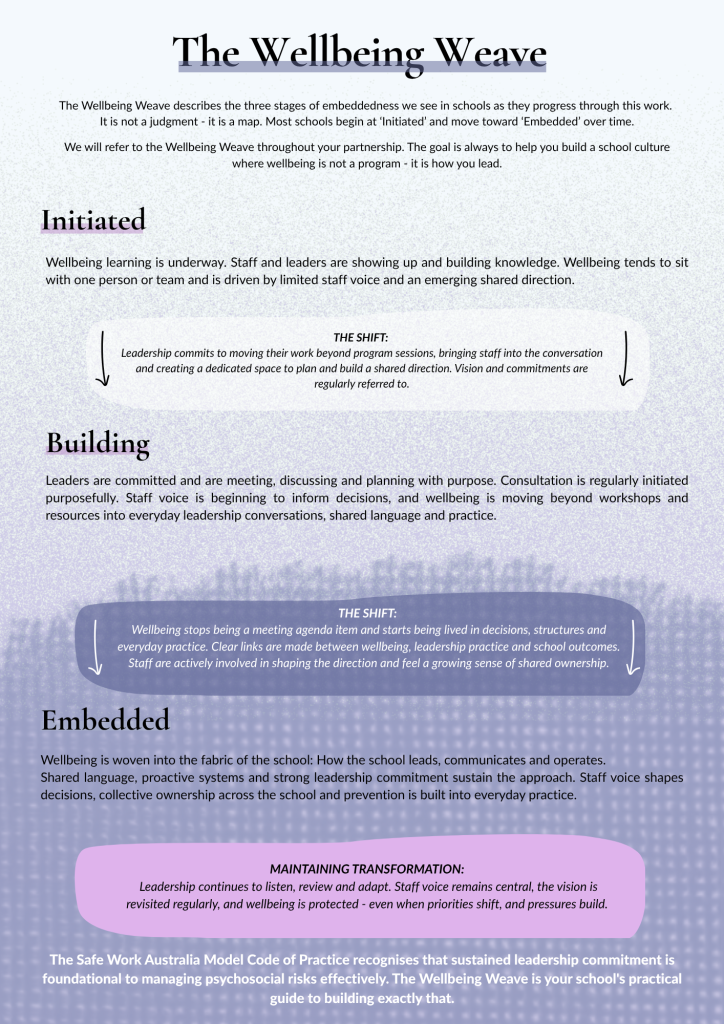
From this partnership data, a clear organisational pattern has emerged. I’ve observed that a school’s journey to weave wellbeing into its fabric isn’t a single, massive leap. Instead, schools naturally progress through three phases: initiating wellbeing, building on it, and finally embedding it.
For clarity, there is no right or wrong phase, nor should there be judgement on how any school has approached wellbeing up until now.
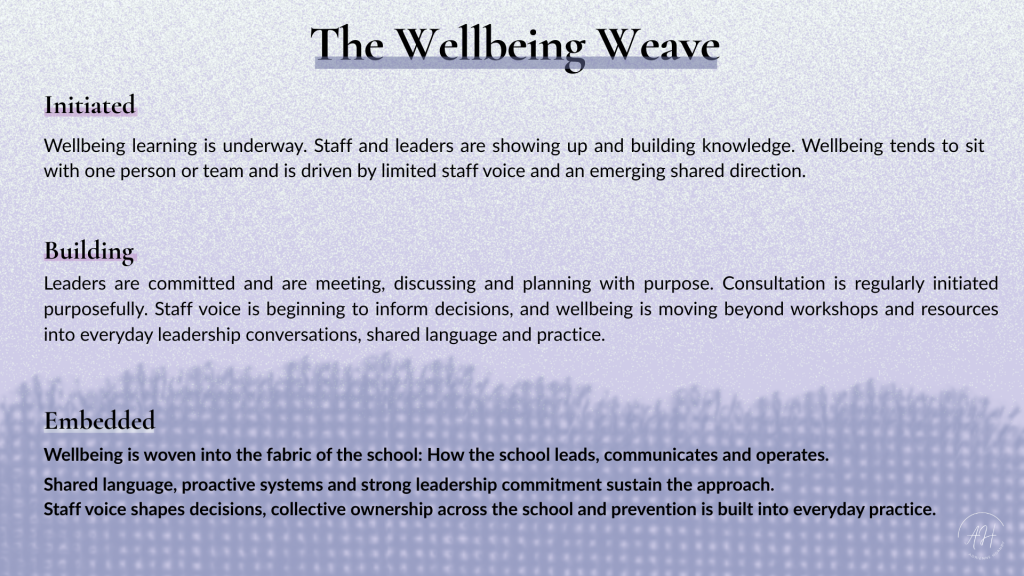
Progression between the phases depends on many interdependent factors that shape how a school develops, consolidates, and, at times, regresses. Awareness of which phase we are in is critical for identifying where to go next and what our leaders and staff need to build and maintain momentum.
This is something I walk our partner schools through. It illustrates how to reach their full potential as a Well-Led School, what is required of them as committed partners, and allows me to share gentle expectations for our time together. It’s important to me that, when I begin working with a school, I’m transparent about the phases we move through and that we risk hitting a ceiling if we don’t put in the required work.
Phase 1: The ‘Initiated’ Phase
The commencement or recalibration phase. This is where most schools are when they first come to work with me. Schools generally land here when they’ve made a conscious decision to make wellbeing part of their culture or approach, or to refocus their efforts. They’re beginning to introduce or reintroduce wellness initiatives, plans or professional learning for leaders and staff.
In this phase, wellbeing activities are usually underway: you might see a keynote speaker at the start of the year, scheduled wellbeing days, a one-off or annual staff survey, and various resources shared around. The activity is happening, and the positive intent is there. However, two distinct markers tend to give the phase away.
- Wellbeing still sits with one person or a small committee
- Strategies are driven by limited or infrequent opportunities to gather genuine staff voice, resulting in an emerging direction, rather than a deeply shared, school-wide commitment.
This is likely so because the leaders or the school are time-poor; juggling multiple competing priorities, they aren’t yet ready for the full breadth of staff consultation, or leader wellbeing, capability or capacity may be stretched or require focus or attention.
Here’s what it looks like in practice:
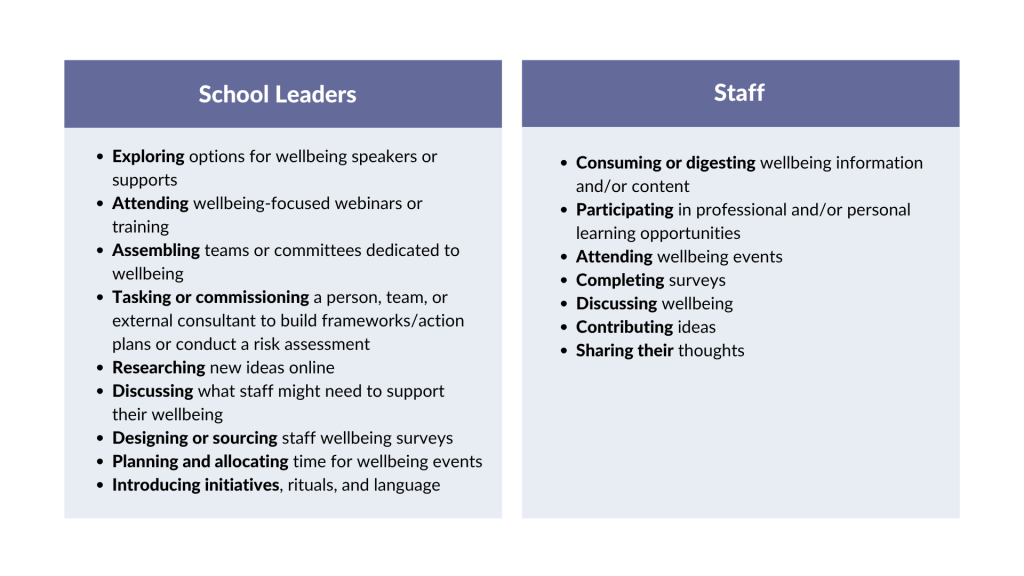
When a wellbeing focus is first introduced, it generally brings motivation, excitement, and sometimes even a sense of relief. But it’s worth noting that not all staff lean in like this.
In some schools, you may experience pushback and cynicism. This trepidation might be the result of previous attempts to support wellbeing that never moved beyond this initial phase, frequent or recent changes in leadership or school focus, or unmanaged stressors, psychosocial hazards and risks that were never properly addressed. Often, staff aren’t ready to buy in because they’re worried the work won’t gain traction and that it’s not worth their energy or hope.
THE SHIFT: Moving beyond the “initiated” phase rests on leadership reflection, practice and drive. School leadership must commit to taking the work beyond program sessions, bringing staff into the conversation, and creating a dedicated space to plan and build a shared direction. Vision and commitments must be co-created, regularly referred to, and progress reviewed and shared often.
The ‘Building’ Phase
In the building phase, schools ensure that what was started in the ‘initiated’ phase becomes a regular and identifiable part of school practice. A big part of my work is to build on wellbeing in a way that’s designed to land with the unique staff make-up of each individual school. This requires consultation, perspective, and ultimately, strong strategy.
In this phase, leaders are committed to wellbeing and psychosocial safety, and are meeting, discussing and planning wellbeing with purpose. Staff can identify that wellbeing is moving beyond workshops and resources and into everyday leadership conversations, shared language and practice. Importantly, consultation with staff is regularly initiated with intention and purpose, both formally and informally, and the link between staff voice and decisions made can easily be identified. Wellbeing is being driven with intentionality, structure and planning- nothing is last minute.
Here’s what it looks like in practice:
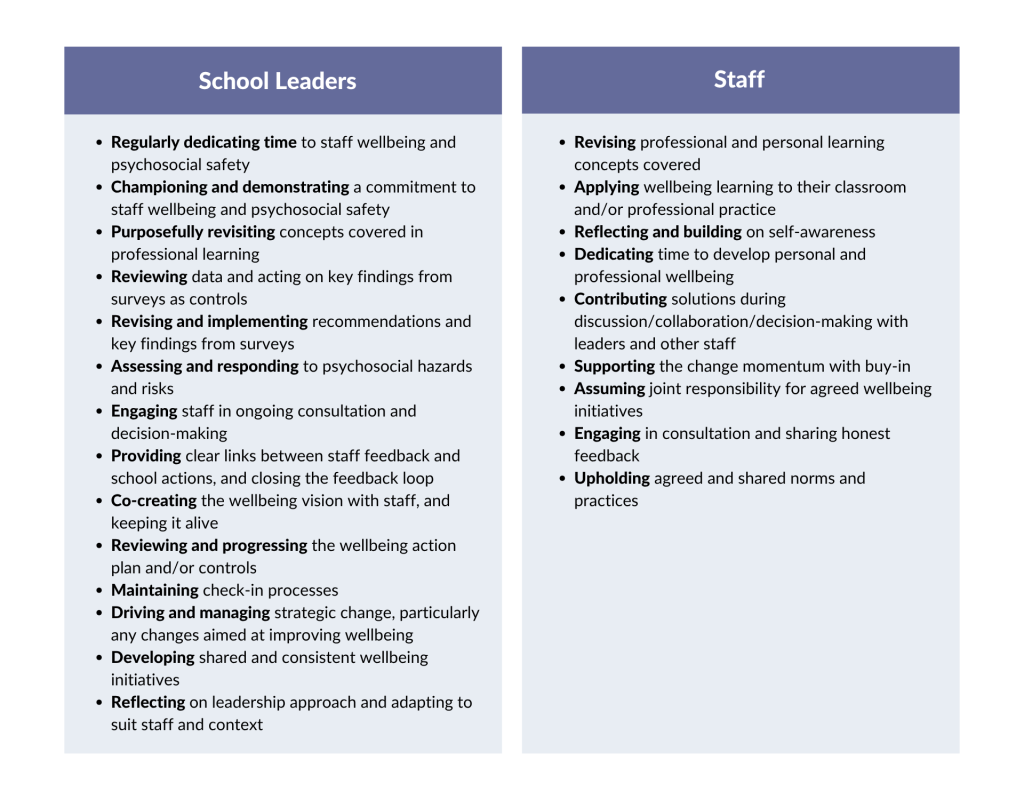
It’s worth being honest about how this phase feels. Consultation and check-ins can still feel planned and scheduled rather than fully authentic, and that’s completely normal. The structure is what makes the authenticity possible later. This is the phase where the work is still deliberate, because it has to be to build rituals and common practice.
THE SHIFT: To move toward the embedded phase, the structures, language and check-ins that once felt planned and deliberate start to become instinctive. The ultimate goal is a cultural evolution: wellbeing stops being just a meeting agenda item and starts being lived through daily decisions, organisational structures and everyday practice.
When this shift occurs, clear links are made between staff wellbeing, leadership practice and broader school outcomes, giving your team clarity and scope. Staff are actively involved in shaping the direction and feel a growing sense of shared ownership in the school’s approach to wellbeing.
Embedding Wellbeing into the School’s “Way of Doing”
In this final phase, wellbeing is woven into the fabric of the school: how it leads, communicates and operates. When I picture the ‘Wellbeing Weave,’ it looks like threads coming from all angles. Leaders, teachers, staff, and the community, all weaving and working together to create something amazing.
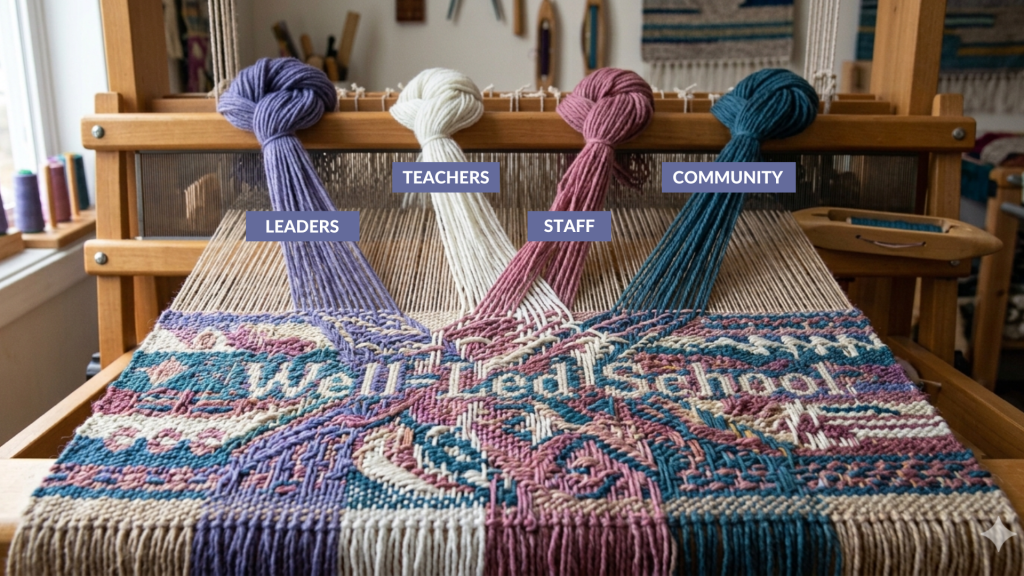
Here, wellbeing becomes the lens through which we process our daily reality. It drives how we think about work, the decisions we make, our short and long-term planning, how the day plays out, and how we reflect and course-correct.
We don’t get here overnight. We get here by realising that only ever initiating wellbeing never really leads to transformation and by recognising, from the building phase, exactly how planned and allocated time works and how our people respond to it. Only then does it transform from a scheduled task into an authentic part of who we are and what we do.
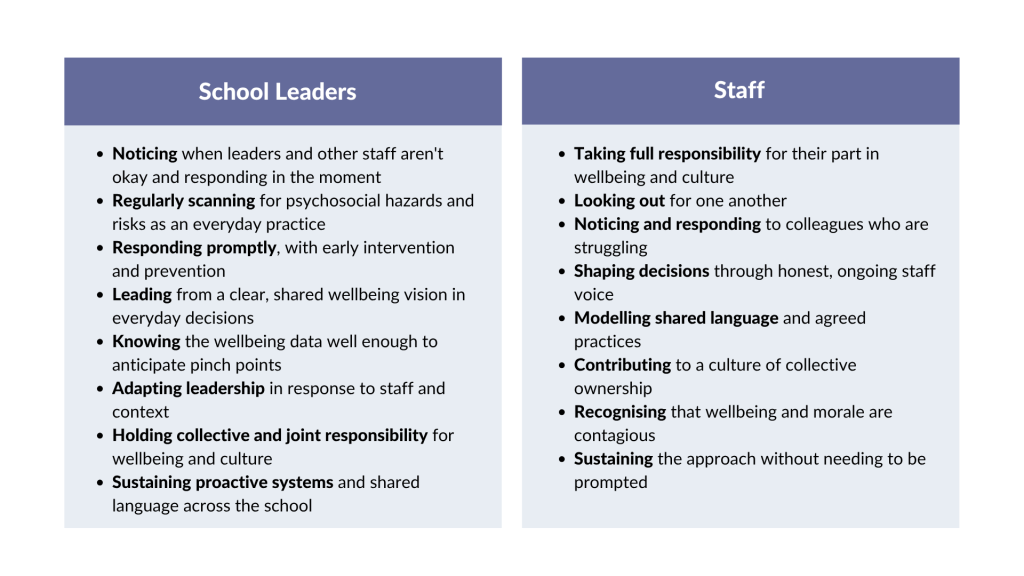
The shift is subtle but unmistakable. Instead of planning check-in times, we instinctively notice when staff aren’t okay and ask them how they’re going. We’re so clear on our strategic vision that in a single conversation we can outline what’s happened, where we’re going next, and how someone’s frustrations, ideas or solutions fit into that plan. We know our wellbeing data so well that we’re aware of the pinch points and the possible risks our ideas and grand plans might carry for staff.
In this space, leadership is constantly scanning for organisational hazards and psychosocial risks, responding promptly through early intervention and preventative practice.
This is the phase where shared language, proactive systems and strong leadership commitment sustain the approach. Staff voice shapes decisions, ownership is collective across the school, and prevention is built directly into everyday practice.
Here’s what it looks like in practice:
Maintaining Transformation
The work doesn’t stop once wellbeing is embedded. This is the part many schools underestimate. ‘Embedded’ is not a finish line; it’s a dynamic standard to hold, and we always need to keep an eye on it.
To maintain this phase, leadership continues to listen, review and adapt. School data must be consistently read, consultation remains an active process, and the overall strategy keeps shifting as the staff and context shift. What worked for one staff group may not serve the next, and structural organisation changes can swiftly introduce rocky territory for your team. Embedded schools expect these shifts, rather than being caught out by them.
Staff voice remains central. It isn’t gathered once and filed away to satisfy a compliance check or risk assessment. It continues to shape decisions, and staff can clearly trace the line between what they raise and what changes. The feedback loop stays open at all times because a truly well-led school knows that consultation must look beyond annual surveys. The vision is revisited regularly, not as a static policy document that lives in a desk drawer, but as a living reference point that leaders and staff return to, measure against, and adjust.
And here is the real test: wellbeing is protected even when competing priorities shift and operational pressures build. Anyone can sustain a wellbeing focus during a calm term. The embedded school holds the line during the complexities when the timetable is under strain, when a crisis hits, or when the easy path would be to quietly let it slide.
That’s when embedded wellbeing proves its true value. It demonstrates that psychosocial safety is part of who the school is, not just something it acts on when there happens to be room on the agenda.
Where The Work Sits, And Where The Magic Is
Wherever your school sits across these three phases, there is no judgement in it. The point of this framework was never to rank schools or to shame leaders. It’s a diagnostic tool designed to recognise where you are honestly, so you know which thread to weave next.
All schools care about and want the best for their staff. I will always believe this, and I’ll always champion the idea that any school can turn its culture around. It simply needs the awareness, openness, capability, capacity, patience and support to do so. I love being that strategic partner for schools- their biggest champion. The reality is, we have more power and control over our organisational health than we think.
When schools come to work with me, I’m always honest about this: what we do inside the partnership program is all about establishing traction in that building phase. We provide our partner schools with the capability development, coaching, reflection and resources to build wellbeing into their daily practices. The program is designed to see everything that needs to be seen, prioritise what matters most, and align a strategic vision with an action plan of exactly how we’ll get there.
But the embedding? That’s the part we hand back to schools.
It’s a cultural shift that no external consultant can force; it’s a standard that every single leader and staff member in a school must collectively ensure. Following a structural hazard and risk assessment process is the easy part. Truly embedding this work requires the unwavering commitment of leaders and management at all levels. Without that internal ownership, even the most data-informed plans can derail.
Ongoing consultation with everybody is the best way to ensure this work becomes woven in. It makes space for knowledge building, awareness and perspective, and lets you hear the targeted solutions your people actually want. No book, article or podcast can do that on its own. When a school community takes that collective ownership, something special happens. It creates a sort of wellbeing magic on the ground, and that’s the transformation we love partnering with schools to achieve.
Ready to weave?
If you’ve recognised your school in the initiated or building phase, and you want to move toward wellbeing that’s genuinely woven in, the Well-Led Schools Partnership Program is built for exactly this work.
Our partnership moves away from typical wellbeing approaches or temporary morale boosters. It’s a data-informed, systemic framework designed to build true leadership capability and shift your underlying organisational conditions. We provide the diagnostic tools, the strategic scaffolding, and the objective perspective required to help your leadership team move beyond reactive initiatives and successfully anchor psychosocial safety into your daily way of doing.
We do the heavy lifting of mapping the data and facilitating the creation of the action plan, so you can focus on leading your people.
Learn more and partner with us or book a clarity call to discuss which thread your school should weave next.
From the blog
Psychosocial Safety Is the School’s Duty, but Everyone Is Responsible for the Work
When we talk about staff wellbeing and psychosocial safety in schools, two camps tend to form. One points to data on stress and burnout and…
Who Owns Staff Wellbeing? Why Leaders Must Make the First Move
I’ve had three calls with principals since the term started. All across different states, sectors, and sizes, and all three said a version of the…
The State of Staff Wellbeing in Australian Schools: What Our National Report of 4,536 Staff Reveals
One in two school staff report feeling burnt out, and only 57% say their workplace has a positive impact on their mental health. For years,…