Understanding Psychosocial Hazards in Schools and Why Generic Frameworks Miss the Mark
For many school leaders, psychosocial risk assessment is being framed as a looming compliance hurdle – yet another “to-do” added to an already overflowing WHS checklist.
I see it differently and more positively. I wish more schools would view this as a natural part of our ongoing consultative improvement practice. The same way we are always reviewing curriculum, refining communication, and reflecting on how we lead, psychosocial safety belongs woven into our everyday work, not bolted on once a year.
In 2022, the Safe Work Australia Model Code of Practice outlined organisational responsibility for identifying and managing psychosocial hazards in the workplace. The model outlines a clear risk management cycle: identify hazards, assess risks, implement controls, and review effectiveness.
This is an important step for school leaders, teachers and staff to improve working conditions, enhance leadership practice and ultimately to enhance school outcomes. When we allow ourselves to see this as less of a compliance task and more of a responsibility and a professional practice opportunity, it becomes extremely beneficial.
Long before psychosocial safety became the latest trend in the wellbeing space, the Well-Led Schools Approach had naturally evolved to prioritise this work as a foundational part of our six-step process. Our framework is grounded in what’s missing from the traditional approaches to wellbeing and the formal risk assessment process: an appreciative inquiry into what is working and why, and opportunities for both leaders andstaff to take collective responsibility and action to improve working conditions.
Another consideration I think we need to unpack is that psychosocial hazards look different in education than in other sectors. Understanding the various hazard and risk categories and how they actually show up in schools is an important skill to cultivate for leaders at all levels and for staff.
This article explores:
- Psychosocial hazards defined
- The compounding effect: why psychosocial hazards rarely travel alone
- What psychosocial hazards actually look like in a school context: the six features that make school psychosocial risk uniquely complex
- Why context is the key to compliance
- What comes next
Psychosocial hazards defined
Under the model Work Health and Safety laws, organisations (including schools and departments) must manage the risk of psychosocial hazards in the workplace.
A psychosocial hazard is anything that could cause psychological or physical harm. It relates to how work is designed, managed, or socially interacted with.
These hazards can create stress, and while stress itself is not an injury, long-term or unmanaged stress can create harm. This can manifest as psychological injury, including burnout, anxiety, depression, post-traumatic stress disorder, or sleep disorders, or physiological harm, such as musculoskeletal injuries, chronic disease, or fatigue-related injuries.
Common psychosocial hazards at work include:
- High or low job demands: consistently excessive workload, time pressure, emotional demands or complexity, or persistently under-stimulating work.
- Low job control: limited ability to influence how work is done; the pace, priorities, or daily decisions.
- Lack of role clarity: unclear, shifting, or conflicting expectations about what a role includes.
- Poor support at work: inadequate practical, emotional, or supervisory support to do the job safely and effectively.
- Poor organisational change management: change introduced without adequate planning, consultation, communication, resourcing, or time to adjust.
- Poor organisational justice: perceived unfairness in decisions, processes, workload allocation, or how people are treated.
- Remote or isolated work: working with limited social, professional, or physical connection to others.
- Inadequate reward and recognition: effort, contribution, and impact are not acknowledged in fair or meaningful ways.
- Conflict and poor workplace relationships: ongoing tension, mistrust, or unresolved conflict that becomes damaging.
- Traumatic events and materials: exposure to distressing incidents or information that can have a lasting psychological impact.
- Poor physical work environment: physical conditions that increase stress, fatigue, or discomfort.
- Bullying, violence and aggression: unreasonable behaviour, threats, abuse, or unwanted conduct.
- Harassment, including sexual harassment: unwanted conduct that creates risk to psychological or physical safety.
For a detailed breakdown of each hazard, what it looks like in a school context, and how it shows up across different roles, you can download my Psychosocial Hazards in Schools reference guide here.
The Compounding Effect: Why Psychosocial Hazards Rarely Travel Alone
We tend to explore hazards in isolation, yet they may interact and combine to create additional, changed, or higher risks. It is our duty as both system and school leaders to consider the hazards our staff might be exposed to and prevent them from becoming risks. In education, we often neglect to think in the big picture or long term when introducing change and idealistic frameworks. We are quick to introduce new plans and initiatives without considering how this might result in hazards or compounding risks.
Some hazards are not risks on their own. Yet, in combination with another, they can change their risk profile entirely. For example, poor change management, role clarity, or leadership communication and clarity can lead to impaired communication and workplace relations (gossip, cliques and/or complaining amongst staff), creating a real risk for the leaders and staff involved. Or, without a clear and systemised approach to student management, in a culture of high performance and high work demands, interruptions to learning due to student behaviour can delay lesson delivery, creating a backlog of untaught or incomplete curriculum.
The pressure, expectation and workload remain. Both of these scenarios, and many more, reduce teachers’ and staff’s perception of their own efficacy – a big problem in a purpose and outcome-based profession.
Something I often hear from senior leaders when I start working with them is “Staff are complaining about the basic administrative tasks that are and have always been a mandatory part of their job…”
That observation is a fair frustration, particularly when administrative tasks are part of the job description, and there’s a school to run. But here’s the harder question. What’s actually under the surface when capable, committed staff start struggling with the basics?
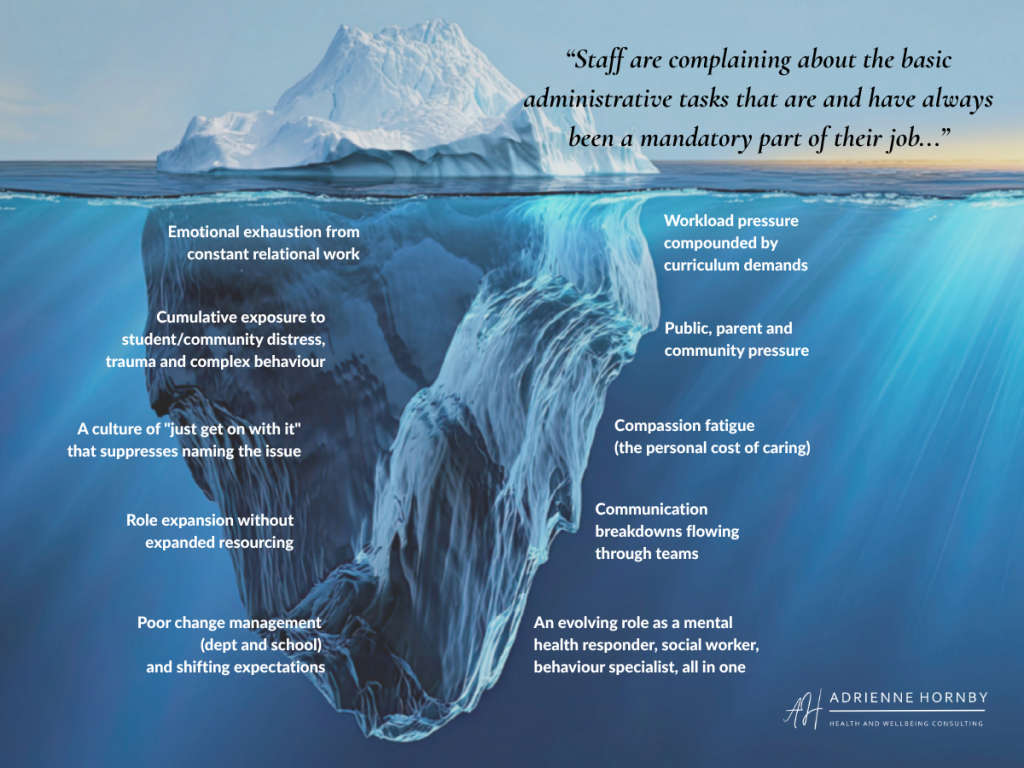
Too often, there is a failure to recognise how these pieces fall in together and impact one another. These are compounding psychosocial hazards, yet they are frequently treated as separate and disconnected. The Code lists hazards as a taxonomy. My survey data across 75+ schools, and my lived experience working inside them, tell me they don’t operate in isolation. They operate as part of a larger ecosystem.
What Psychosocial Hazards Actually Look Like in a School Context
Psychosocial hazards exist in every workplace. The Safe Work Australia Code of Practice gives us a strong national framework for identifying and managing them. But the Code was written for workplaces in general, not for schools specifically.
When we apply it directly to a school without translation, important things get missed. The hazards are still there. They just don’t fit neatly into the categories or operate in isolation, making them harder to identify and meaningfully control.
Here are six features of school work that make psychosocial risk uniquely complex in education and schools, and why they deserve named attention in your risk management approach.
1. The work is emotional and relational, not just operational
In most workplaces, emotional labour is a sub-category of job demands. In schools, it is the job.
Teaching is a highly emotional and relational profession. Every interaction with a student, a parent, or a colleague carries an emotional weight. Staff are not just delivering content. They are holding people, regulating rooms, absorbing distress and taking responsibility far beyond their job description!
Carroll et al. (2022) found that emotion regulation, workload pressures and subjective wellbeing were all critical factors in teacher stress and burnout, with over half of the sample reporting they were very or extremely stressed and considering leaving the profession.
The Code names emotional effort in a single bullet point under high job demands. In schools, it deserves its own conversation.
What this means for risk identification: measuring hours worked or tasks completed will undercount the actual load. We need to ask about the emotional and relational nature of the work and how we support that, not just the volume.
2. Chronic exposure to student trauma, distress and complex needs
Staff are not exposed to trauma or distress once. They are absorbing student disclosures, behavioural escalations and family distress continuously, across years, different schools and many roles or classes as “part of the job.” This is closer to what the clinical literature calls secondary or vicarious traumatic stress, and it requires different controls than a one-off critical incident.
Our survey data shows that, on average, 42% of staff identified managing difficult and challenging student behaviour as a top stressor (with some schools reporting higher percentages than others), with catering for diverse and complex student needs close behind.
The ACU Principal Wellbeing Survey (Riley et al., 2021) consistently finds that school leaders experience offensive behaviour, threats and violence at rates several times higher than those in the general workforce.
What this means for risk identification: the Code’s category of traumatic events and materials needs to be read in schools as ongoing and cumulative, rather than episodic.
3. Caring is the job, and the personal cost of caring is real
Teaching and education attract people who care deeply. That care is the engine of the work, and also one of its greatest risks. The line between professional responsibility to care and the personal toll of caring is genuinely blurred in education.
This is where individual self-care or coping language can cause harm or frustration if it is not done well, or not held alongside genuine recognition of the complexities of the role. When we tell staff to manage their own boundaries around something the work itself is designed to demand, we shift the regulatory burden from the school or system to the person.
What this means for risk identification: you cannot solve a structural hazard with an individual intervention. Personal wellbeing strategies have a role, but they belong alongside organisational controls, not instead of them.
4. The role of school leaders is in itself a psychosocial risk environment
This one deserves care to name well. School leaders are both the people responsible for managing psychosocial risk for their staff, and the people experiencing some of the highest levels of it themselves. The ACU Principal Wellbeing Survey shows that principals experience burnout and sleep disruption at rates well above those in the general workforce. Many of the leaders we work with are carrying a significant load while trying to hold space for the load of others and embed strategic initiatives.
Robinson, Lloyd and Rowe (2008) established that leadership has its largest effect on student outcomes through the conditions it creates for staff. The same is true for psychosocial safety. Leadership practice shapes the conditions in which hazards either escalate or are contained.
Putting it bluntly, if our leaders aren’t okay, how can everyone else be?
What this means for risk identification: leadership conditions are themselves part of the risk profile. They cannot sit outside the assessment. Leaders also need to be considered as a worker group in their own right, with their own hazards and controls. Leaders are also directly responsible for the rollout of many initiatives and changes meant to address psychosocial risk.
The psychological and emotional space for them to participate in training, professional development, coaching and mentoring is essential if we want the controls to be effective and managed well.
5. The role keeps expanding without expanding resourcing
The role of an educator has evolved in practice and expectations: at times, it feels like we are mental health responders, social workers, behaviour specialists, disability support workers, family liaisons and trauma-informed practitioners, in addition to teachers or support staff. The evolving expectations of the role have outpaced the training, time, resourcing, budgets, supervision and staffing to meet them.
AITSL’s 2022 Spotlight Review on Wellbeing in Australian Schools, the OECD’s TALIS 2024 Australia report and Lemon and McDonough (2023) all document this scope expansion or ”the scope creep”. Staff are not failing to keep up. The role itself has evolved and changed shape.
To add to all of this, public, parent, and community expectations are immense, often shaped by a perspective on what educators do that overlooks the complexities of daily school life and the time available to do it.
What this means for risk identification: a lack of role clarity and inadequate reward and recognition are all named in the Code. In schools, they are deeply linked to this mounting pile of responsibilities. Clearly naming what is and is not the work of a teacher or staff member, both internally and for external stakeholders (and society!), is itself a psychosocial risk control measure.
6. “Getting on with it” is part of the professional culture
There is a long-standing professional norm in education that good teachers cope, manage and carry on. It is a culture of quiet endurance. This makes it harder for staff to name what is actually causing harm or stress, and harder for leaders to see hazards before they become risks.
I hear a lot in schools about how we used to leave our stuff at the school gate, but now it carries through into the classroom, the staffroom and our interactions with one another. Here is the thing, though. When we were getting on with it before, we weren’t really getting on with it. It was likely transferring to other areas of our lives. Now it’s harder to hide from. I’d bet that more people are uncomfortable with the current circumstances of the “baggage” people carry into work, because we are still building the human skills to support adult wellbeing, and to manage our own.
Collie and Carroll (2023 )found that the combination of low autonomy and high time pressure was strongly linked to teachers’ emotional exhaustion and intentions to leave the profession. Essentially, pressure builds quietly, and often before staff feel able to raise it (or, at times, notice it!). Amy Edmondson‘s work on psychological safety reminds us that without explicit permission and structures to speak up, the most affected staff are often the most silent.
What this means for risk identification: the Code creates a positive duty on schools to identify hazards regardless of whether staff name them outwardly. You cannot rely solely on staff voice or complaints data.
Proactive, structured and ongoing identification methods are essential. This is where strong relational and consultative leadership at all levels, applied consistently, truly matters.
Why Context is the Key to Compliance
These six features are the reasons we must apply the Code of Practice through an education-specific lens. They highlight why we must recognise the ongoing nature of the work, embedding it deeply in our everyday leadership, team dynamics and inter-staff practices.
The risk management cycle (identify, assess, control, review) still works in schools. However, to be effective, it needs to be informed by the unique factors that shape work in our sector. This requires a dual approach: formal assessment cycles paired with informal, regular interactions we have with our staff, teams and individuals.
We know things change week to week, across terms and with different cohorts – what worked one week might fall away the next. We must have our finger on the pulse and our ear on the ground.
This is exactly the work we do inside the Well-Led Schools Partnership Program. We translate the regulatory framework into a school-specific approach, ensuring psychosocial safety is woven into the way a school leads, rather than being bolted on as a lone annual compliance process.
This is why a generic risk register or a tick-and-flick survey rarely produces meaningful outcomes for schools. The data gathered needs to be specific, staff-informed, and interpreted with an understanding of how schools actually function.
In a follow-up article later this term, I’ll dig into the four-step risk management cycle and the two key factors that determine whether it creates real change or simply produces paperwork: management commitment and staff consultation. These are the elements that sit underneath the cycle, and they are where the real work lives.
Want to go deeper?
If you’d like a detailed reference for each psychosocial hazard, including what it looks like in a school context and across different roles, you can download my free Psychosocial Hazards in Schools guide.
Understanding your school’s specific hazard profile starts with looking at the broader national landscape. In our 2026 State of the Nation: Staff Wellbeing Across Australian Schools report, we map how these exact psychosocial hazards and organisational conditions break down across seven distinct ICSEA school bands.
Our Staff Wellbeing Survey has recently been updated to align more closely with the Safe Work Australia Code of Practice. We now include a structured psychosocial hazard section, psychological safety indicators, and a headline psychosocial safety perception metric that gives schools a trackable baseline to work from. When you partner with us, the data you gather directly supports both the identification and assessment phases of your school’s formal risk management process.
Explore the Well-Led Schools Partnership Program to understand the structure and framework of our 12-month program, and discover whether it’s what your school needs to embed wellbeing and psychosocial risk compliance into everyday cultural practices.
And if you’d like to explore whether this work is the right fit for your school, you can book a clarity call.
References
- Australian Institute for Teaching and School Leadership (AITSL). (2022). Spotlight: Wellbeing in Australian schools. AITSL, Melbourne. https://www.aitsl.edu.au/research/spotlights/wellbeing-in-australian-schools
- Carroll, A., Forrest, K., Sanders-O’Connor, E., Flynn, L., Bower, J. M., Fynes-Clinton, S., York, A., & Ziaei, M. (2022). Teacher stress and burnout in Australia: Examining the role of intrapersonal and environmental factors. Social Psychology of Education, 25(2–3), 441–469.
- Collie, R. J., & Carroll, A. (2023). Autonomy-pressure profiles among teachers: Changes over a school term, leadership predictors, and workplace outcomes. Teaching and Teacher Education, 124, 103998.
- Edmondson, A. C. (2019). The fearless organization: Creating psychological safety in the workplace for learning, innovation, and growth. Wiley.
- Friedman, T., Ainley, J., Schulz, W., & Dix, K. (2025). TALIS 2024 Australian Report: The Teaching and Learning International Survey. Australian Council for Educational Research (ACER).
- Hascher, T., Beltman, S., & Mansfield, C. (2021). Teacher wellbeing and resilience: Towards an integrative model. Educational Research, 63(4), 416–439.
- Lemon, N., & McDonough, S. (2023). “I feel like nothing else will ever be this hard”: The dimensions of teacher resilience during the COVID-19 pandemic. The Educational Forum, 87(4),
- Lemon, N., & Turner, K. (2024). Unravelling the wellbeing needs of Australian teachers: A qualitative inquiry. The Australian Educational Researcher, 51, 2161–2181.
- Riley, P., See, S-M., Marsh, H., & Dicke, T. (2021). The Australian Principal Occupational Health, Safety and Wellbeing Survey (IPPE Report): 2020 Data. Australian Catholic University, Institute for Positive Psychology and Education.
- Robinson, V. M. J., Lloyd, C. A., & Rowe, K. J. (2008). The impact of leadership on student outcomes: An analysis of the differential effects of leadership types. Educational Administration Quarterly, 44(5), 635–674.
- Safe Work Australia. (2022). Model Code of Practice: Managing psychosocial hazards at work. Commonwealth of Australia. https://www.safeworkaustralia.gov.au/doc/model-code-practice-managing-psychosocial-hazards-work
From the blog
The State of Staff Wellbeing in Australian Schools: What Our National Report of 4,536 Staff Reveals
One in two school staff report feeling burnt out, and only 57% say their workplace has a positive impact on their mental health. For years,…
Understanding Psychosocial Hazards in Schools and Why Generic Frameworks Miss the Mark
For many school leaders, psychosocial risk assessment is being framed as a looming compliance hurdle – yet another “to-do” added to an already overflowing WHS…
What 4,536 Australian Educators Told Us About School Staff Wellbeing | Season 4: Episode 13
Only 57% of Australian school staff report that work positively affects their mental health, and 1 in 2 are currently experiencing burnout. When I sat…