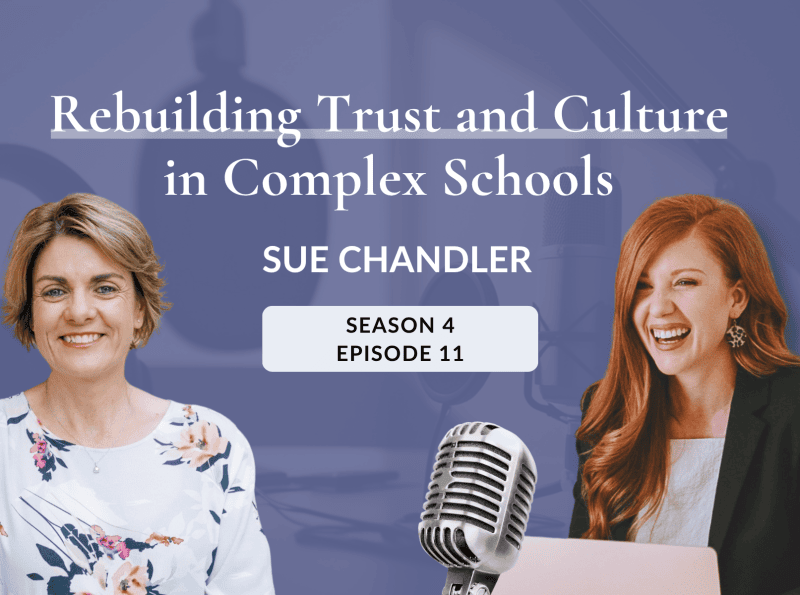
Rebuilding Trust and Culture in Complex Schools with Sue Chandler | Season 4: Episode 11
Staff in below-average ICSEA secondary schools reported the toughest conditions in the State of Staff Wellbeing in Australia report, with poor leader-staff communication at an average of 71%, staff shortages at 63%, and lack of trust amongst staff sitting at 58%.
The data tells a clear story of stacking stressors, incivility and leadership churn. In these complex environments, capable leaders are constantly being pulled into reactive mode, away from the very thing their school needs most: relational connections.
But I am reluctant to encourage these leaders to “be more relational,” as the complexities in these schools make that part of the job more challenging. Instead, I want to explore real, practical ways to build relationships and trust amidst strain.
This week, as part of our Band 1H spotlight, I am joined by Sue Chandler, educational consultant, mediator and author of The Relational School. Drawing on over three decades of experience across teaching, counselling, school leadership and conflict resolution, Sue partners with schools to design relational frameworks and build cultures where both wellbeing and engagement can thrive.
Together, we unpack why a relational culture in complex schools is part of the core infrastructure that everything else depends on. We explore why real cultural change doesn’t live in a wellness workshop, but in the small, repeated organisational moves leaders make every day.
In this episode, we cover:
- Why Sue rejects the term “behaviour management”, and what shifting “behaviour development” actually asks of school leaders
- How treating behaviour as communication reframes student and staff challenges as a lack of skill rather than a lack of will
- Why relying solely on restorative practice arrives too late if we fail to proactively solve the underlying problems driving behaviour
- How staff exhaustion is directly fueled by bolting relational approaches onto fundamentally compliance-based systems
- How to find the “warm demander” sweet spot by balancing high relationships with high accountability, rather than trading one for the other
- Why the exact same relational skills must be applied consistently across students, staff and parents to build true whole-school alignment
- How to build relational culture into a school’s architecture so it survives leadership churn and system disruption
About Sue Chandler
Sue Chandler is an education consultant and author of The Relational School. She works with schools across Australia to help leaders build cultures where relationships, professional thinking and organisational systems work together to support both staff and students. Sue is passionate about helping schools move beyond behaviour management towards lasting cultural transformation.
Links and Resources Mentioned in the Episode:
- The Relational School (Sue’s book)
- State of the Nation: Staff Wellbeing Across Australian Schools
- Band 1H blog article
- Well-Led Schools Partnership Program
- Dr Ross Greene, Collaborative and Proactive Solutions:
Connect with Sue Chandler via:
Her website: www.transformativeschools.com.au
LinkedIn: www.linkedin.com/in/suechandler/
Connect with me via:
Website: adriennehornby.com.au
LinkedIn: www.linkedin.com/in/adrienne-hornby-a4126a205/
Email: hello@adriennehornby.com.au
From the blog
Who Owns Staff Wellbeing? Why Leaders Must Make the First Move
I’ve had three calls with principals since the term started. All across different states, sectors, and sizes, and all three said a version of the…
The State of Staff Wellbeing in Australian Schools: What Our National Report of 4,536 Staff Reveals
One in two school staff report feeling burnt out, and only 57% say their workplace has a positive impact on their mental health. For years,…
What 4,536 Australian Educators Told Us About School Staff Wellbeing | Season 4: Episode 13
Only 57% of Australian school staff report that work positively affects their mental health, and 1 in 2 are currently experiencing burnout. When I sat…