
Six Ways to Involve Staff in Authentic Wellbeing Consultation
“We consulted staff. We sent the survey.” It’s a phrase I hear a lot, usually from leaders who’ve tried to support their staff and are puzzled about why the survey didn’t change anything.
The reality is that a survey alone is not consultation. It’s one tool in a much bigger process, and if the rest of that process hasn’t been acknowledged, staff don’t experience being heard. They experience it as being asked to do one more thing.
I’m sharing this in term four on purpose. Nobody is running a consultation process in the last three weeks of the year, and I wouldn’t ask you to. But this is exactly the time to look back at how your school consulted this year, be honest about where it fell over, and decide what the rhythm looks like starting next year.
Over this term I’ve written about who owns staff wellbeing and the three layers of responsibility for psychosocial risk management. Consultation is the glue holding all of this together, because it’s the one through-line the Code of Practice weaves through every other. You can’t identify hazards, assess risk, choose controls, or review them without it.
So before anything else, one thing needs to be clear. Consultation is a senior leadership duty. The Work Health and Safety Act states that the school must consult workers who are, or are likely to be, affected by a health and safety matter. Senior leaders plan it, coordinate it, resource it and own the follow-through. Middle leaders and staff have a part to play, and I’ll come to that, but nobody below the senior team can make this happen on their own.
Here are the six things I’d get right.
1. Plan it before you open your mouth
The most effective leaders I work with treat consultation like any other strategic process. They decide what they’re consulting on, who needs to be in the room, and what decision-making authority actually sits with staff before the conversation starts.
When planning consultation, we can fall into the trap of making it too “teacher-centric,” involving our teaching staff and not other staff groups. The Code is clear that consultation covers everyone affected, including support staff, part-timers, relief staff, and the people who rarely speak in a staff meeting. If your consultation only hears from the loud and the available, you’ve consulted a subset and are missing groups which may need attention and support. This might mean that you plan surveys, focus groups and/or individual and small team sessions to ensure you capture the viewpoints of all.
We also rarely prepare our mindset. Not just the one who walks into the room or sets up the survey to ask for feedback, but the mindset to receive it. If you go in to listen but end up defensive, staff will feel it in the first thirty seconds. Go in with curiosity to learn and observe perspectives and behaviours.
2. Be clear about what consultation is, and isn’t
This is where a lot of trust gets lost, on both sides. Staff hear “consultation” and expect their suggestion to happen instantaneously. Leaders hear “consultation” and feel they’ve just signed up to grant every wish that lands in the suggestion box.
You’re not a genie in a bottle; you do not have to grant every wish.
The Code describes consultation as sharing relevant information, giving workers a reasonable opportunity to express their views, and taking those views into account before deciding. It also outlines that the decision still rests with the school. So being honest about what can and can’t change isn’t cold. It’s compliant, and it’s kind.
I encourage schools from the start to very transparently outline, “We will listen to everything. We will act on what we can, and we’ll tell you why we can’t on the rest.” Then make sure you do exactly that.
3. Run it with safety and curiosity
Staff only engage when they believe their ideas and concerns will be taken seriously, and leaders build or break that belief with what they do in the room on the day. Who speaks first, how the first critical comment is handled, and whether a leader’s face changes when their own decision or a strategic decision is named as a gripe.
Great leaders ask great questions, and are curious about the lens staff are looking through when they answer. Two people in the same school can see the same decision completely differently, and that’s not a problem to argue with. It’s very interesting data about the state of wellbeing and staff mindset. I have noticed in my work that once someone holds a story about their leaders or school, they start noticing everything that confirms it and very little that doesn’t. There’s a reason for this. The reticular activating system is the brain’s filter, deciding what gets attention out of everything happening around us, and it prioritises whatever we’ve already decided matters; in psychology, it’s called confirmation bias. In most cases, you can’t talk someone out of their own assumptions or perspectives instantly. You can only get curious about how they drew it. Shifting perspectives is an art, and it often begins with validation: meeting staff where they are, building trust, and then communicating differently to shift perspectives or open staff up to complexity and context.
This is where I encourage leaders to start to develop a hunch about how the school got here, and where the honest ones take responsibility for their part. Staff will often “soften” or let their guard down when they see a leader take responsibility. Leaders always go first.
4. Review it as a team, with a strategic lens and some gratitude
After the consultation, the work moves to the leadership table, and the tone there has as much of an impact as it does in the staffroom.
Feedback is absolute gold for a school improvement process. Everything that came through is one of three things:
- A solution you can use
- An insight into how staff are experiencing the school
- Or a mindset you now know exists.
All three are useful. None of them are attacks. If a team can hold that frame, review becomes strategic rather than defensive, and you stop sorting feedback into “fair” and “unfair” and start sorting it into “now”, “later,” and “not possible, and here’s the context for why”.
If your team can’t review objectively yet, involve an impartial person to help you progress.
5. Close the feedback loop
This is the step most often skipped, and it determines whether staff will ever contribute again.
The Code requires schools to advise workers of the consultation outcome in a timely manner. In practice, the mistake isn’t usually silence, though that happens. The more common mistake is justification. Leaders come back to staff with a list of reasons why things can’t change, delivered with just enough defensiveness that staff hear “we asked, we didn’t like the answer”. That repels people and, more often than not, won’t give you a second round, or they’ll go quiet.
Closing the loop means saying what you heard, what you’re doing, what you’re not doing and why, and when they’ll hear from you next. On a recent episode of the Well-Led Schools Podcast, Stuart McKenzie called it “you said, we did”, and his point is that half of psychosocial safety is telling people what you did or what you are in the process of doing.
6. Make it a rhythm, not an event
A once-a-year survey followed by a once-a-year staff meeting is not consultation; it’s an annual tick-and-flick. Staff experience the school weekly, so the listening has to be more regular too. The good news is that you already have the meetings. You don’t need a new structure. You just need to add consultation on the agendas you already run.
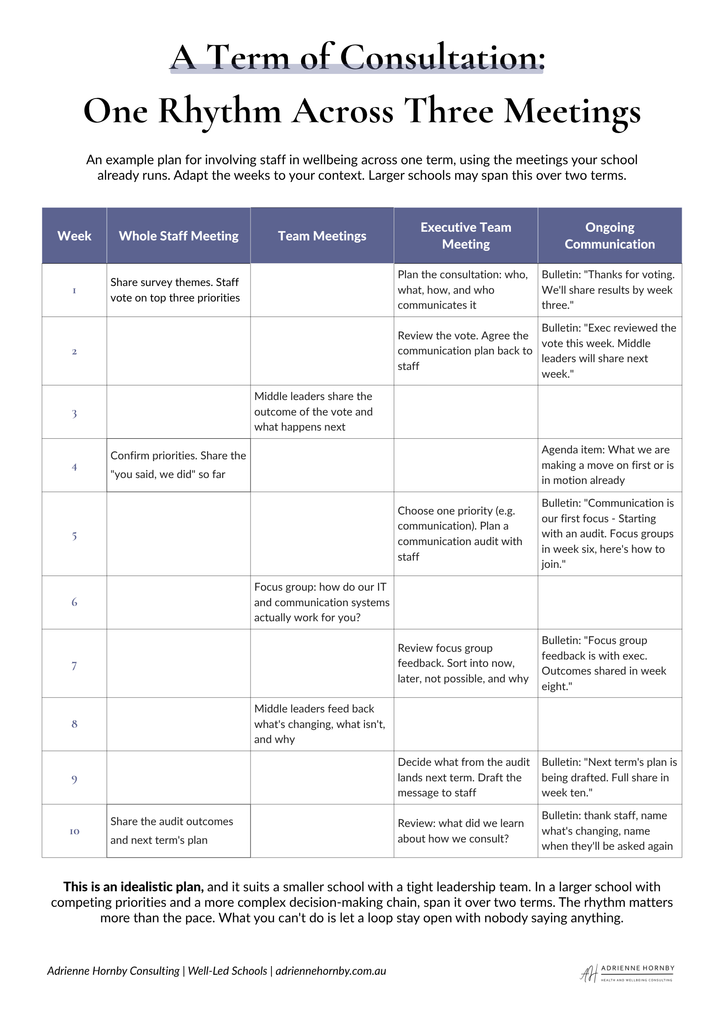
The table below shows what one term could look like across three meetings most schools already hold, plus the ongoing communication that sits in between.
That right-hand column is the one most schools forget, and I’d argue it makes the most difference and builds momentum for change. Consultation and progress take time. Reviewing feedback properly takes weeks; decisions have to go through the right people, and some things can’t be answered or progressed this term. Being real about that is fine. Going quiet about it is not.
The research on organisational change is consistent on this. Uncertainty, not bad news, is what drives anxiety and disengagement during change, and regular communication about the process reduces it even when there’s nothing new to announce (Bordia, Hobman, Jones, Gallois and Callan, 2004). Staff who feel the process was fair and transparent accept decisions they disagree with far more readily than staff who feel it was done to them. That’s procedural justice, and it’s one of the strongest predictors of trust in leadership we have (Colquitt, Conlon, Wesson, Porter and Ng, 2001). So “we’ve read everything, it’s with the executive team, you’ll hear from us in week eight” is a perfectly acceptable control.
Notice the plan isn’t every week in every meeting. It’s one touchpoint most weeks, moving between the three layers, and every loop gets closed before the next one opens. Another example I like is Stuart McKenzie’s dynamic psychosocial risk assessment process, where he recommends doing something similar in twenty minutes every fourth week.
Download the PDF and bring it to your next leadership meeting
Where middle leaders and staff fit
Senior leaders own this, but they don’t do it alone.
Middle leaders are the transmission point. They listen in their teams, stay curious rather than defensive, and carry what they hear up the chain. Then they carry the answer back down. That second half only works if the broader leadership team agrees on a tight communication plan: who says what, when, and the same message from every mouth. Staff can tell when four leaders are giving four versions.
And staff have to play their part and contribute professionally. Bring the solution alongside the complaint where you can. Once the loop has been closed and you’ve heard the why, give the decision a fair go and look for small progressions. That’s the part we play in shifting culture, morale and collective wellbeing.
Consultation done well is not a bigger workload. It’s the same meetings, run with a different intent, and it’s the difference between staff who stop filling in the survey and staff who turn up to the focus group.
How to kick off next year on the right foot
If you want next year to feature this kind of authentic consultation, that’s exactly how the Well-Led Schools Partnership Program begins. Term one starts with a school scan: staff are surveyed once the term has settled, multiple sets of data are reviewed with your leadership team, and then with staff, the feedback loop is closed properly, and a strategic vision for staff wellbeing is built directly on what your people actually told you. Applications for a Term 1 2027 start are still open, and booking a Clarity Call is the easiest way to see if it’s a fit for your school.
And if the program isn’t right for you, download the term table from this article, bring it to your leadership team before the year ends, and ask one question: which of these six did we miss this year?
References
- Safe Work Australia (2022). Managing Psychosocial Hazards at Work: Code of Practice. Chapter 3, Consultation.
- Work Health and Safety Act 2011 (Cth), sections 47 to 49.
- Bordia, P., Hobman, E., Jones, E., Gallois, C. and Callan, V. J. (2004). Uncertainty during organizational change: Types, consequences, and management strategies. Journal of Business and Psychology, 18(4), 507 to 532.
- Colquitt, J. A., Conlon, D. E., Wesson, M. J., Porter, C. O. L. H. and Ng, K. Y. (2001). Justice at the millennium: A meta-analytic review of 25 years of organizational justice research. Journal of Applied Psychology, 86(3), 425 to 445.
From the blog
The State of Staff Wellbeing in Australian Schools: What Our National Report of 4,536 Staff Reveals
One in two school staff report feeling burnt out, and only 57% say their workplace has a positive impact on their mental health. For years,…
Six Ways to Involve Staff in Authentic Wellbeing Consultation
“We consulted staff. We sent the survey.” It’s a phrase I hear a lot, usually from leaders who’ve tried to support their staff and are…