
Psychosocial Safety Is the School’s Duty, but Everyone Is Responsible for the Work
When we talk about staff wellbeing and psychosocial safety in schools, two camps tend to form. One points to data on stress and burnout and concludes that educators must build resilience, coping, and regulation within a taxing role. The other points to the conditions and the legal obligation of every workplace to manage psychosocial hazards and workplace wellbeing. Both are right, and you can’t have one without the other. Interventions that target only the individual or only the organisation underperform those that do both (LaMontagne et al., 2014). Psychosocial safety is what happens when leadership, culture, and systems reduce the preventable harm work can do to people.
My position has been firm for years: staff wellbeing is a joint responsibility, and most schools I come across resonate with that. Staff deserve a workplace that prioritises their wellbeing. But they also have a responsibility to look after themselves and others, because they chose to work in a community and they are role models for children and young people who rely on them.
Declaring the collective effort is the first step. Agreeing is the second. Clarifying what it means for each person is where the attention needs to go if we want to get anywhere.
Psychosocial safety, and where the work sits
Psychosocial hazards are the pressures built into how work is designed, organised and led: workload, role clarity, communication, change, support, relationships, behaviour and so on. The Code of Practice asks every school to identify them, assess the risk, control it and review it, with management commitment and consultation wrapped around all four steps (Model Code of Practice: Managing psychosocial hazards at work, 2022).
The Code already names who holds what responsibility: the school carries the primary duty, the principal and executives have a duty of due diligence, and everyone else is a worker with a duty to take reasonable care. Here we see three clear layers of responsibility.
Where the work sits: the Staff Wellbeing Sweet Spot
Before I break down the three layers, it’s important to clarify the core focus of their work because the Act describes only half of it. Staff wellbeing has two parts: the conditions of the work, which the school holds and the law regulates, and the personal wellbeing each person brings to work and takes home from it, which no legislation can reach. The Staff Wellbeing Sweet Spot is where the two meet and overlap, and it’s the overlap the three layers are really managing.
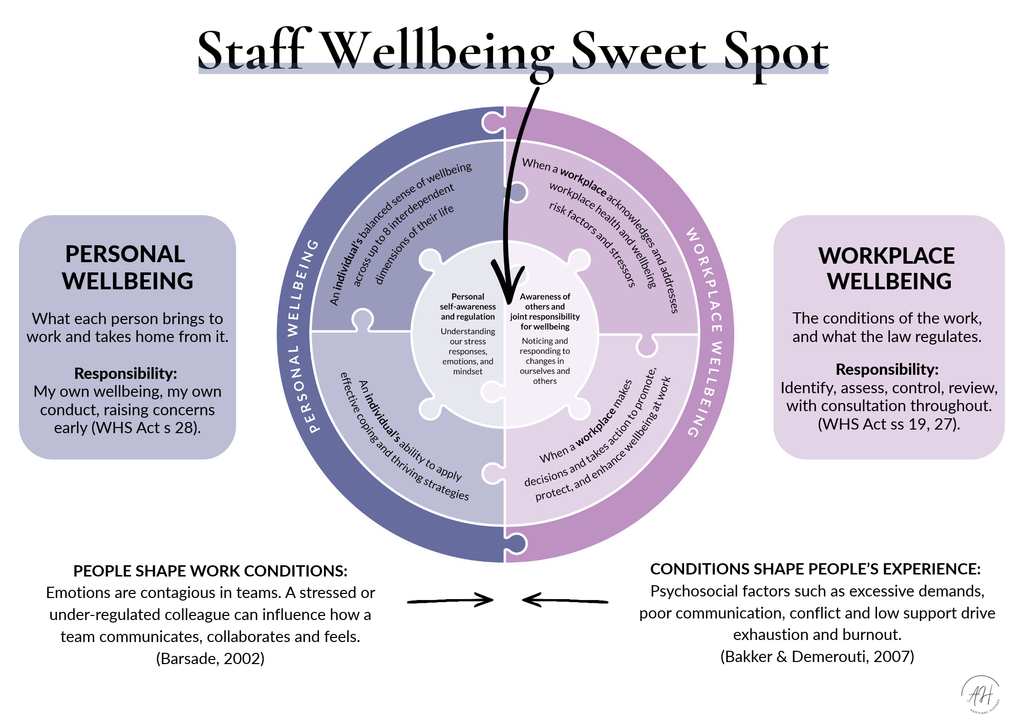
The Code regulates only one side of staff wellbeing, workplace wellbeing and the conditions of the work, and those conditions read almost word for word like the Code’s hazard list, such as low role clarity and poor support and organisational change management. Personal wellbeing- the self-awareness, regulation and coping each person brings to work sits outside its reach. The two meet in the Staff Wellbeing Sweet Spot, and the arrows run both ways: excessive workload and poor communication drive exhaustion and burnout (Bakker & Demerouti, 2007), and a stressed, under-regulated colleague changes how a whole team communicates and feels (Barsade, 2002).
Our national data lives at that meeting point: morale is at 50%, and only 57% of staff say their workplace positively affects their mental health (Hornby, 2026). You can’t manage the workplace side well without understanding the personal side, and you can’t ask people to manage the personal side inside conditions that work against them. That’s why responsibility has to be shared, in a defined way, across three layers.
Why “everyone’s responsibility” so often becomes nobody’s
When responsibility is spread across a group without being assigned, each person assumes someone else is acting, and nobody does. In schools, the gap gets filled by whoever is most passionate, usually a wellbeing coordinator or a single leader, who ends up in charge of the consultation, the plan and the follow-through for everyone. It rarely works, and it usually burns out the person trying to hold it all together. This approach only ever initiates wellbeing, rather than truly building and embedding it
This is why step 3 of the Six Steps to Becoming a Well-Led School is to clarify the joint responsibilities for staff wellbeing and psychosocial safety, and why it comes after the scan and the shared vision and language rather than before. You can’t assign responsibility until everyone can see what the work entails and agree on its purpose. Once that is established, the work is divided across the three layers outlined below, each representing a different role in the same process, with consultation running through all of them.
Each layer runs the same four steps (identify, assess, control, review) at a different scale: the school, the team and the self.
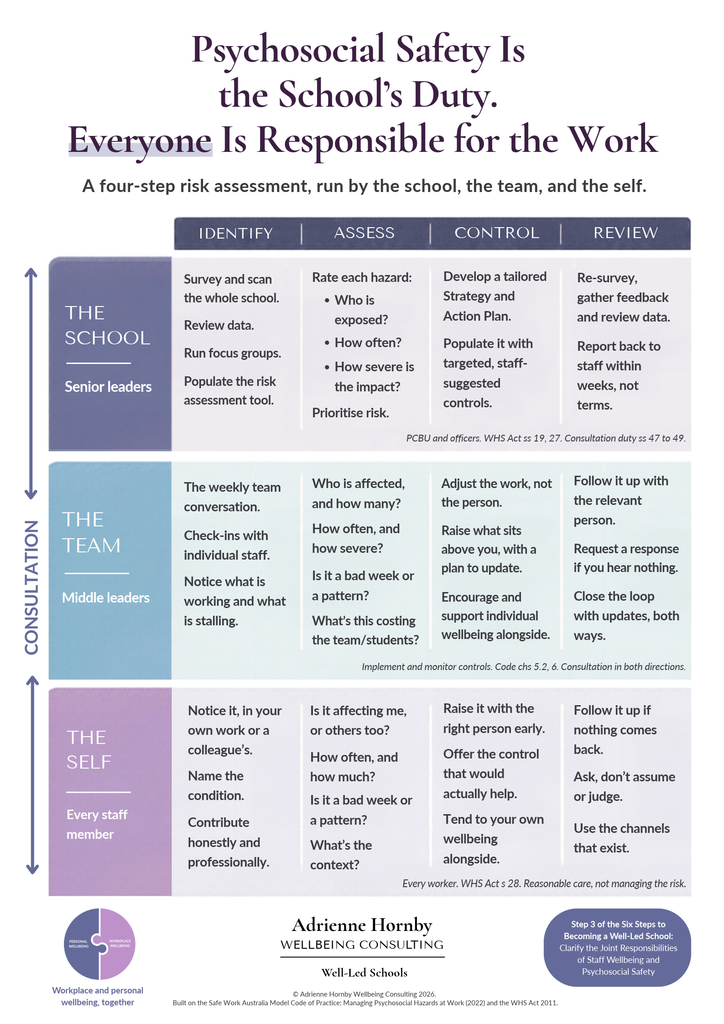
Download the poster as a PDF: printable and shareable with staff
Layer one – The School (Senior leaders): Own the process, structure the consultation, and lead the listening
Senior leaders hold the primary duty and levers, so they own the four steps of psychosocial risk management. Identify and assess is where the annual survey or scan, focus groups and psychosocial risk assessment sit. They sign off on the controls and the timeline, ensuring consultation is properly resourced rather than remaining surface-level. Senior leaders own the review: officers have a personal duty to verify that the school’s processes are “performing effectively” (s 27), which in most schools means this duty sits with the principal and senior leadership, and in systemic schools the system too.
The second job is structure. Formal consultation once a year is sensible given the time schools have, but it only works inside a rhythm: scheduled check-ins, clear timelines, and a point each term where the leadership team asks “What did we hear, what did we do, and what have we told staff?” That means pathways connecting team pulse checks to whole-school decisions, so what a faculty raises in week three reaches the executive table by week five. The Principal Standard asks for exactly this, a “consultative approach” with staff (AITSL, 2014). Without structure, even the best conversations lose momentum.
The third job is the hardest. Consultation produces truth only when the people at the top can hear it without defending first. Staff decide whether to speak up based on how their leader responded last time, and a defensive response teaches silence faster than any policy teaches openness (Detert & Burris, 2007; Morrison, 2014). This does not mean never offering context. It means getting the order right: validate first, plan what you can act on, then explain with compassion what you can’t grant. Validation is what lets a person hear the context that follows (Linehan, 1993), and an honest “no, and here’s the context,” builds more trust than silence (Shapiro, Buttner & Barry, 1994).
Layer two – The Team (Middle leaders): Implement, notice, and carry consultation in both directions
The duty to manage risk sits with the school, but middle leaders often implement and monitor the controls, and their consultation duty runs in both directions. These leaders are closest to the conditions staff experience and the first to notice when something is working or stalling. The senior layer builds the systems and safety that let them do this well; when those are missing, the work is harder, but it does not stop. Influence at this level predicts whether improvement ever reaches the classroom (Leithwood & Mascall, 2008; Harris, 2013).
Their consultation is formal and incidental. Formal, in supporting school-wide consultation processes with genuine intent and treating a survey as the start of a conversation rather than a task to tick off a list. Incidental, in team meetings that discuss not just “wellbeing” but the conditions underneath it: how workload is distributed this term, how decisions are communicated, student behaviour and the support around it, how staff are working together.
This is also where I want to take some of the weight off the words “psychosocial risk assessment.” The formal version, with the survey, the register and the leadership review, happens once or twice a year and sits with senior leaders. But the four steps play out on a smaller scale every week in a well-led team.
- A head of department hears three teachers say the new reporting template is doubling their marking time: that is a hazard identified.
- She asks how many hours and who is carrying it: that is the risk assessed.
- She trims the template for her faculty and raises the rest with the deputy: that is a control, chosen with the people affected.
- She checks in two weeks later: that is the review.
Nobody called it a risk assessment, yet it was one. Middle leaders who see their everyday problem-solving this way stop waiting for the formal process to give them permission.
Middle leaders have a responsibility to notice. The stress and mental health continuum gives middle leaders a shared language for seeing a colleague shift from thriving to reacting to struggling, long before anyone says burnout (Keyes, 2002). Every corridor conversation, staffroom complaint or daily debrief is consultation: notice, check in, hear the person out, resolve what you can, and say where the rest is going and when they’ll hear back.
The job that ties it together is translation. Middle leaders listen impartially, validate the concern without agreeing or disagreeing, and either solve it or feed it upward with a solution-focused lens: “here’s what I’m hearing, what we’ve tried, what we need.” Then they bring the answer back down with a response, a plan, or a timeline. It’s fine not to have the answer. It’s not fine to leave consultation unaddressed or to not respond at all. Knowing how a decision was made and being told the outcome predicts trust more reliably than getting what you asked for (Colquitt, 2001).
None of this is purely procedural. It draws on attributes leaders keep developing: communicating across personality and working styles, attending so people feel heard, building rapport and trust (Bryk & Schneider, 2002), and the Middle Leader Standards name the disposition: responding “to critical feedback in a non-defensive manner” (AITSL, 2025). One more thing. Middle leaders are the layer most likely to be overloaded and least likely to be consulted. Checking in on middle leaders is a responsibility that falls directly to senior leadership.
Layer three – The Self (Every Staff Member): notice it, name it, offer the solution, follow it up
Psychosocial risk management and consultation is not something done to staff. Choosing to work in a school is choosing a collaborative community, and that comes with a part to play. The WHS Act names it as a duty to take reasonable care and to cooperate with reasonable policies (s 28). It’s a duty to take care, not to manage the risk. In practice, it’s the same four steps every staff member can use in their own work.
- Identify: notice when something about the work is taking a toll on you or on a colleague, and name it as a condition rather than a personal failing.
- Assess: ask whether it’s a bad week or a pattern, and who else is affected.
- Control: tell the right person and offer a solution that would actually help, not just the complaint, because those closest to the daily work are usually best positioned to suggest a practical solution.
- Review: if nothing comes back or changes after a reasonable time, ask professionally, respectfully, and through the right channel, rather than assume it was ignored and say so in the staffroom or the car park. Staff have every right to ask where their feedback went.
- Tend to your own wellbeing: Staff who are not regulated cannot consult well, advocate clearly, or support themselves and others.
Done this way, staff don’t have to wait for the annual survey to be consulted. When consultation isn’t offered, staff should direct feedback through the channel that exists rather than venting behind the staffroom door. I understand why venting happens. It might be because safe channels don’t exist or aren’t clear. And because it’s a release, it can feel like solidarity, and it’s often the only place people feel heard. But the research is consistent. Negative emotion in a group is contagious (Barsade, 2002); a few persistently negative voices can shift the mood and performance of a whole team (Felps, Mitchell & Byington, 2006), and complaining sideways instead of speaking up is what organisational psychologists have long called neglect: the response to dissatisfaction that changes nothing and corrodes everything (Rusbult et al., 1988). Every complaint that bypasses the channel is information the people who could act on it never receive. Leaders are responsible for creating the channels and the safety, and this behaviour breeds in their absence. I still gently encourage staff to do better here, for their colleagues, students and community.
What this looks like on paper
None of this survives on intention alone. Schools can develop a shared consultation plan every layer can see, and the Code requires the process to be recorded (ch 7). That keeps the three layers honest about who is responsible for what, and if a regulator ever asks how your school manages psychosocial risk, the consultation plan, the wellbeing action plan and the vision and wellbeing strategy are the evidence.
Four things belong in it:
- The rhythm: Annual formal benchmarks (the survey or scan, the whole-school risk assessment review), term-by-term check-ins and updates, and the weekly team-level conversations where the mini assessments happen, with the mode clear for each.
- The cycle: For any major issue, when consultation happens, how long the review takes, who decides, and how the loop is closed. “We heard you, here is what we are doing first, and here is why we cannot do X yet” is a complete answer. Silence is not. (I wrote about this in Turning Insights into Action).
- Report-back timelines. Staff know, before they give feedback, roughly when they will hear back. The Code says “in a timely manner”. I say weeks, not terms.
- The grievance and complaints pathway. Who to go to, what support exists, what each layer holds at each step, and how to escalate. When this is clear, far fewer issues require formal escalation, because people trust that the pathway is there.
One more thing the Code insists on explains why so many schools feel busy and stuck. Controls that change the work (redistributing workload, streamlining communication, redesigning a role) are preferred over controls that help people cope (training, an EAP, a wellbeing day), which the Code calls the “least reliable” and asks to be used last and in combination with the others (s 5.1). That applies at every scale. A faculty trimming a template or a teacher proposing a fix to their own workload is choosing a control that changes the work, and the Code would prefer it to a resilience session every time. When the concern is workload or conditions, the first question is always whether the work can be adjusted rather than the person. That is the preferred direction, and it is a leader’s most practical lever.
Lumen Christi College in WA chose three priorities from their scan inside the Well-Led Schools Partnership Program: workload, communication and planning time. They built controls around those conditions, and twelve months later all three sat below the national averages. A written plan means nothing if it doesn’t shift daily practice.
The forgotten step: the follow-through
The document is the first step, not the last. Leaders at every level keep it alive: refer to it, review it, guide staff back to it when something is raised (or not). The Code requires controls to be maintained and reviewed rather than filed (chs 5.2 and 6), and trust is built by behaviour repeated over time, not by what is written down (Bryk & Schneider, 2002). Sticking a plan to the staffroom wall and expecting staff to follow it is the same mistake as creating team norms that get filed away and forgotten.
In short
Managing psychosocial risk is one process, run at three layers. Senior leaders run it for the whole school and build the structure that holds it. Middle leaders run it for their teams, notice early, and carry what they hear in both directions. Every member of staff applies these steps to their own daily work and uses the channels that exist. Consultation is what moves information between the three. Everyone follows the same four steps, for the whole school, for a team, or for themselves.
Ready to put this into practice?
This term I am running a complimentary 90-minute online training, Psychosocial Risk Management: A Practical and Authentic Approach, the practical version of everything in this article. Sessions run Thursday, November 5 through November 19. Secure your spot here.
References
AITSL (2011). Australian Professional Standards for Teachers. Melbourne: Australian Institute for Teaching and School Leadership.
AITSL (2014). Australian Professional Standards for Principals and the Leadership Profiles. Melbourne: AITSL.
AITSL (2025). Australian Professional Standards for Middle Leaders. Melbourne: AITSL. [confirm publication year on the PDF]
Bakker, A.B., & Demerouti, E. (2007). The Job Demands-Resources model: State of the art. Journal of Managerial Psychology, 22(3), 309 to 328.
Barsade, S.G. (2002). The ripple effect: Emotional contagion and its influence on group behavior. Administrative Science Quarterly, 47(4), 644 to 675.
Bryk, A.S., & Schneider, B. (2002). Trust in Schools: A Core Resource for Improvement. New York: Russell Sage Foundation.
Colquitt, J.A. (2001). On the dimensionality of organizational justice: A construct validation of a measure. Journal of Applied Psychology, 86(3), 386 to 400.
Detert, J.R., & Burris, E.R. (2007). Leadership behavior and employee voice: Is the door really open? Academy of Management Journal, 50(4), 869 to 884.
Felps, W., Mitchell, T.R., & Byington, E. (2006). How, when, and why bad apples spoil the barrel: Negative group members and dysfunctional groups. Research in Organizational Behavior, 27, 175 to 222.
Harris, A. (2013). Distributed leadership: Friend or foe? Educational Management Administration & Leadership, 41(5), 545 to 554.
Hornby, A. (2026). State of the Nation: Staff Wellbeing Across Australian Schools. Adrienne Hornby Wellbeing Consulting.
Keyes, C.L.M. (2002). The mental health continuum: From languishing to flourishing in life. Journal of Health and Social Behavior, 43(2), 207 to 222.
LaMontagne, A.D., Martin, A., Page, K.M., Reavley, N.J., Noblet, A.J., Milner, A., Keegel, T., & Smith, P.M. (2014). Workplace mental health: Developing an integrated intervention approach. BMC Psychiatry, 14, 131.
Leithwood, K., & Mascall, B. (2008). Collective leadership effects on student achievement. Educational Administration Quarterly, 44(4), 529 to 561.
Linehan, M.M. (1993). Cognitive-Behavioral Treatment of Borderline Personality Disorder. New York: Guilford Press.
Morrison, E.W. (2014). Employee voice and silence. Annual Review of Organizational Psychology and Organizational Behavior, 1, 173 to 197.
Rusbult, C.E., Farrell, D., Rogers, G., & Mainous, A.G. (1988). Impact of exchange variables on exit, voice, loyalty, and neglect. Academy of Management Journal, 31(3), 599 to 627.
Safe Work Australia (2022). Model Code of Practice: Managing Psychosocial Hazards at Work. Canberra: Safe Work Australia.
Shapiro, D.L., Buttner, E.H., & Barry, B. (1994). Explanations: What factors enhance their perceived adequacy? Organizational Behavior and Human Decision Processes, 58(3), 346 to 368.
Work Health and Safety Act 2011 (Cth), ss 19, 27, 28, 47 to 49.
From the blog
Psychosocial Safety Is the School’s Duty, but Everyone Is Responsible for the Work
When we talk about staff wellbeing and psychosocial safety in schools, two camps tend to form. One points to data on stress and burnout and…
Who Owns Staff Wellbeing? Why Leaders Must Make the First Move
I’ve had three calls with principals since the term started. All across different states, sectors, and sizes, and all three said a version of the…
The State of Staff Wellbeing in Australian Schools: What Our National Report of 4,536 Staff Reveals
One in two school staff report feeling burnt out, and only 57% say their workplace has a positive impact on their mental health. For years,…