
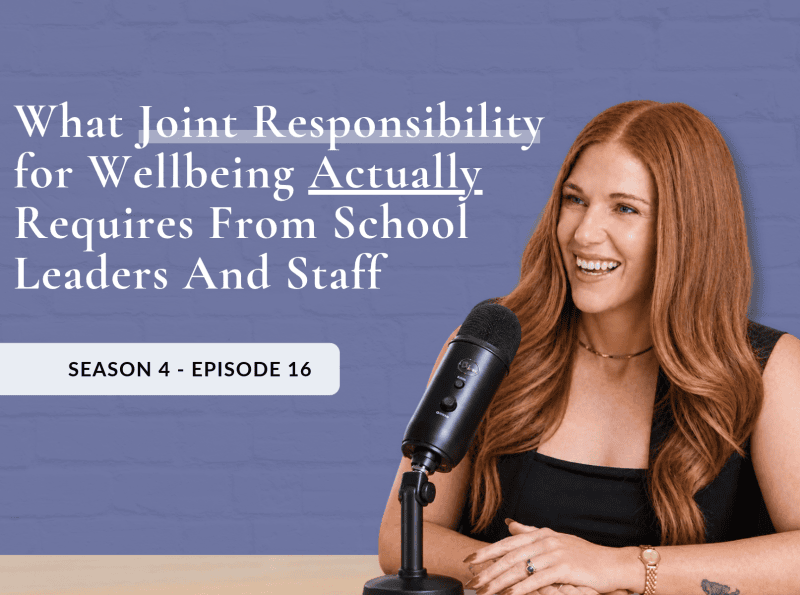
What Joint Responsibility for Wellbeing Actually Requires From School Leaders And Staff | Season 4: Episode 16
Most schools agree that staff wellbeing is a joint responsibility. Staff nod along when it’s presented. Yet across our national dataset of over 4500 educators, only 50% report positive morale, and only 57% say their workplace positively affects their mental health. When good intentions are everywhere, but the numbers remain stubbornly flat, the issue isn’t buy-in; it’s operational clarity about who holds what, and in what order.
This term, three principals in different states and sectors asked me a version of the same thing: staff expect the school to fix things, so what part do they play? That question made me reflect on how my answer has evolved since I first wrote about this debate in 2022. Since then, studying the psychosocial Code of Practice, alongside thousands of hours of data collection and consultations with school communities, has brought sharp clarity to the sequence required to create genuine change.
In this solo episode, I explain why “everyone’s responsibility” so often becomes nobody’s, why leaders have to make the first move, and why clarifying joint responsibility sits at step three of the Six Steps to Becoming a Well-Led School: not too early, not too late. I then walk through the three layers of responsibility, from the formal process senior leaders own, to the mini risk assessments middle leaders run every week, to the part every staff member plays in creating a psychologically safe team culture, speaking up early, and engaging with solutions.
In this episode
- How my thinking on joint responsibility has evolved since 2022, and what changed it
- The three camps: personal resilience, workplace conditions and the system, and why they all need each other
- The Staff Wellbeing Sweet Spot, and why emotions and morale are contagious in teams
- Why “everyone’s responsibility” ends up resting on the most passionate person in the school until they burn out
- Why schools jump to wellbeing days and EAPs, and what the Code says about those controls
- The principal who opened a staff session with an apology, and what happened next
- Why clarifying joint responsibility is step three, and what goes wrong when it comes too early or too late
- The three layers: the school, the team and the self, with consultation running through all of them
- Changing the work before helping people cope, at every scale
LINKS AND RESOURCES
- Poster: Psychosocial Safety Is the School’s Duty. Everyone Is Responsible for the Work
- Article: Psychosocial Safety Is the School’s Duty, but Everyone Is Responsible for the Work
- Article: Who Owns Staff Wellbeing? Why Leaders Must Make the First Move
- Article (2022): The Hot Debate: Who is Actually Responsible for Teacher and Staff Wellbeing?
- Article: The Wellbeing Weave: The Three Phases of Addressing Staff Wellbeing in Well-Led Schools
- Join this term’s FREE online training, Psychosocial Risk Management: A Practical and Authentic Approach
Connect with Adrienne
- LinkedIn: linkedin.com/in/adrienne-hornby-a4126a205
- Email: hello@adriennehornby.com.au
- Well-Led Schools Partnership Program: adriennehornby.com.au/school-partnerships
From the blog
Psychosocial Safety Is the School’s Duty, but Everyone Is Responsible for the Work
When we talk about staff wellbeing and psychosocial safety in schools, two camps tend to form. One points to data on stress and burnout and…
Who Owns Staff Wellbeing? Why Leaders Must Make the First Move
I’ve had three calls with principals since the term started. All across different states, sectors, and sizes, and all three said a version of the…
The State of Staff Wellbeing in Australian Schools: What Our National Report of 4,536 Staff Reveals
One in two school staff report feeling burnt out, and only 57% say their workplace has a positive impact on their mental health. For years,…
What Joint Responsibility for Wellbeing Actually Requires From School Leaders And Staff | Season 4: Episode 16
Most schools agree that staff wellbeing is a joint responsibility. Staff nod along when it’s presented. Yet across our national dataset of over 4500 educators,…